Online Plinko Game: Play Free, Demo or Real Money

Online Plinko is a fast, ball-drop casino game run by a random number generator (RNG) and a fixed table of multipliers. This guide shows Kiwi players how Plinko works, what free demo play actually teaches you, and how to read return-to-player (RTP) figures, risk levels and payout structures before any real-money wagering.

«In casino reviews and game guides, transparency isn't a perk, it's the baseline. Translating complex multiplier tables into plain maths, and explaining how volatility actually works, gives Kiwi players the straight facts they need before dropping a single ball.» Source: Cameron “Cam” Ellery, Senior Editorial Voice, PlayWise NZ.

Last updated: February 2026 · Reviewed by: Cameron “Cam” Ellery, Senior Editorial Voice, PlayWise NZ · Audience: New Zealand players aged 18+

Affiliate and transparency disclosure: PlayWise NZ is free to read. Some links to licensed operators on this page are commercial partner links, and a commission may be earned if you register or deposit, at no extra cost to you. Commercial relationships never influence RTP figures, review notes, bonus maths or scoring. Every platform passes the same five-step review process: licence verification, bonus-terms audit, deposit and withdrawal checks, responsible-gambling tooling, editorial sign-off.

Provider

BGaming

RTP

99.00%

Volatility

High

Min bet

NZ$0.10

Max bet

NZ$100

Max win

x1000

Online Plinko Game Play Free, Demo

Quick Summary: Plinko Game Card

ParameterDetail
Game typeInstant win / arcade casual (not a pokie)
Core mechanicBall drop through a peg pyramid (Galton board)
Typical RTP range95% to 99% (BGaming builds reach 99%)
VolatilityPlayer-selectable: Low / Medium / High
Rows (board size)8 to 16 rows (9 to 17 landing slots)
Max multiplier8x on Low risk, up to 555x, 1,000x or higher on High risk
Typical bet range (NZD)NZ$0.10 to NZ$100 per drop
Key providersBGaming, Spribe, Hacksaw Gaming, Betsoft, Smartsoft, Blitzcrown
Demo available?Yes, free demo, usually with no registration
FairnessCertified RNG and/or Provably Fair (SHA-256 / HMAC-SHA512)
DifficultyBeginner-friendly; no skill element, pure chance
MobileHTML5 browser play on iOS and Android; portrait orientation recommended

In one paragraph: Plinko drops a ball down a pegged pyramid, and where it lands decides your multiplier. You can widen or narrow the payout spread by changing the risk level and row count, but you cannot change the house edge. Play the free demo to learn the interface, then treat real-money play as paid entertainment with strict deposit and loss limits.

Why This Guide Matters Before You Deposit

Plinko looks simple. That is exactly why it gets misread.

The ball bounces, a number appears, and the maths behind it stays invisible unless someone spells it out. Most Kiwi players meet Plinko through a crypto casino clip or a streamer hitting a 555x edge slot, which is the least representative outcome the game produces.

This guide is written for two situations. First, you have played pokies before and want to know whether Plinko offers better value than a 96% slot. Second, you are cautious, new to online casinos, and your real question is whether any of this is safe and legal in New Zealand right now.

Here is what the following sections give you:

  • A plain-English explanation of the peg board, the binomial spread and why the middle wins so often.
  • Real RTP and multiplier figures by risk level, with a worked example in NZ dollars.
  • What demo mode genuinely teaches, and what it quietly hides.
  • A licence, payout and KYC checklist to run before your first deposit.
  • Honest bonus maths, including the case where a 40x wager costs more than the bonus is worth.
  • Bankroll rules and limit tools, woven in rather than bolted on at the end.

One PlayWise NZ principle sits under all of it: describe the method, publish the downsides, and let you decide.

Why This Guide Matters Before You

What Is Plinko Game and How Does It Work?

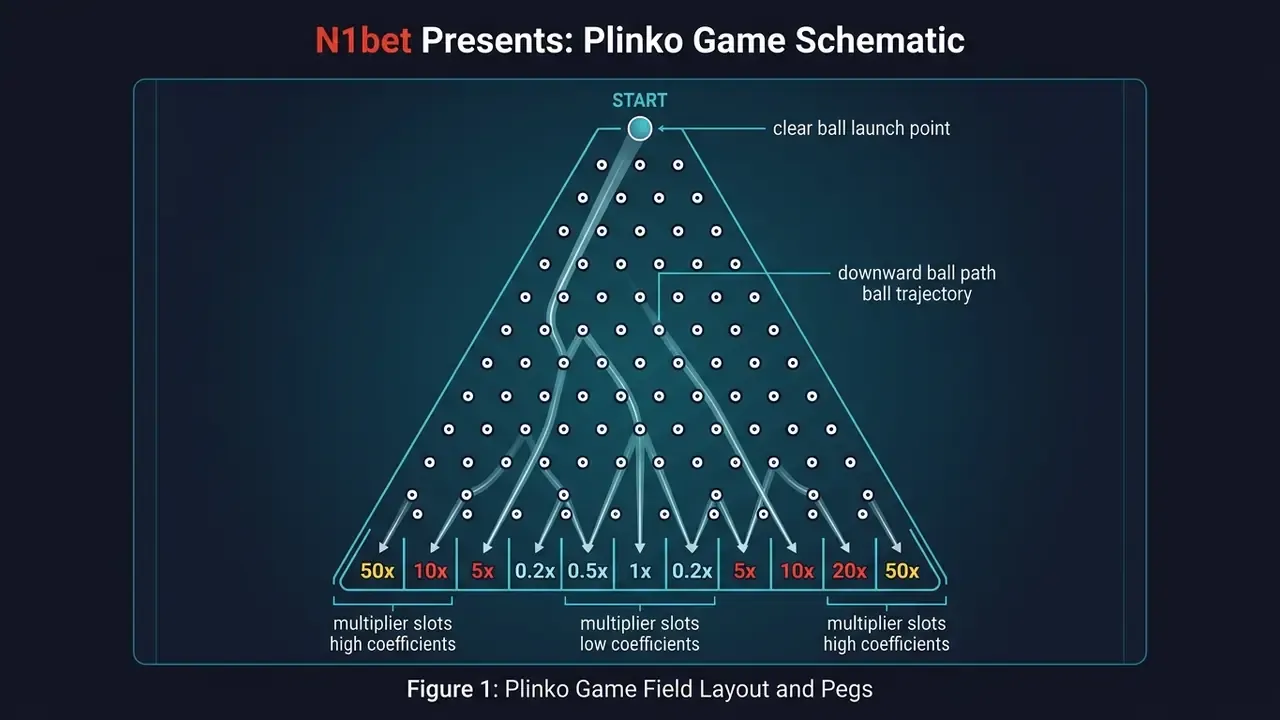
Plinko is a pure-chance, ball-drop casino game. A virtual ball is released from the top of a triangular peg board, deflects off pegs on the way down, and settles in a bottom multiplier slot. Your payout is the stake multiplied by the coefficient printed on that slot. Unlike reel-based online casino games, Plinko replaces spinning symbols with a chain of random left-or-right bounces, which is why the animation feels closer to a physics toy than a pokie.

Historical Origins: From the 1983 TV Show to Online Crypto Casinos

Plinko was created by television producer Frank Wayne and debuted on the American game show The Price Is Right on 3 January 1983, during Bob Barker's long tenure as host (1972 to 2007, later succeeded by Drew Carey). Contestants dropped flat plastic chips down a pegboard roughly 10 feet tall into cash slots ranging from $0 to $10,000. The segment quickly became one of the most recognisable pricing games on the longest-running game show in television history, a series first broadcast in 1956 and restructured into its now-iconic One Bid, Pricing Games and Showcase Showdown format in 1972.

In the late 2010s, software studios digitised that Galton-board visual for the online market. BGaming released its casual Plinko title on 28 January 2019, Spribe followed with a colour-coded risk build, and crypto-first platforms such as Stake and Roobet popularised “Originals” versions verified through Provably Fair random number generation. The result is the instant-win format Kiwi players see today: the same falling ball and pegs, now with adjustable rows, selectable volatility, published RTP figures and cryptographic outcome verification instead of a studio audience.

Historical Origins From the 1983 TV

How the Ball Bounces Through Pegs and Forms a Payout

The ball's movement follows a Galton-board model. At each collision with a peg the path splits 50/50, left or right. Across a board with $N$ rows, the cumulative sequence of deflections produces $2^N$ possible physical paths.

That produces a binomial distribution. In plain terms, the ball is far more likely to finish in the central slots than at the extreme edges.

«On a 16-row board the central slot is hit roughly 19.6% of the time, while each extreme edge slot appears about once in 65,536 drops.» Source: PayoutVerdict, technical analysis of provably fair Plinko systems (2026).

The maths above is standard for any staggered peg lattice. It is also independently checkable through published RNG certification methodology from accredited testing laboratories such as iTech Labs and eCOGRA, which audit real outcome distributions against the theoretical model. The landing probability $P$ for bucket $k$ on an $N$-row grid is defined by the binomial mass function:

$$P(k) = \binom{N}{k} (0.5)^N$$

If the formula looks intimidating, read the short version instead: the middle of the board collects the overwhelming majority of drops, and the far edges are statistical outliers. That one sentence explains almost every payout pattern you will see in a session.

The bottom row of multipliers is pre-assigned by the developer. Low coefficients sit in the high-probability central slots, and the big multipliers are parked in the rare outer-edge slots. The payout resolves the instant the ball settles.

The maths above is standard for

How Plinko Differs From Slots and Traditional Casino Games

Casino lobbies often file Plinko next to online slots and pokies, yet the mechanics are genuinely different:

  • No reels or paylines. Slots rely on spinning reels, matching symbols and fixed or expanding paylines. Plinko uses a vertical pegboard with no reels and no payline overlay.
  • Player-adjustable volatility. In a pokie, volatility is locked into the game code. In Plinko you set the board yourself, choosing the number of rows (usually 8 to 16) and a risk level (Low, Medium or High).
  • Payout transparency. Every round shows the full multiplier grid at the base of the board, so you can read the exact coefficient for each landing slot before the ball is launched.
  • No bonus rounds. Classic Plinko has no free spins, wilds, scatters, gamble feature or bonus buy. Everything is on screen from the start, which is both the charm and the limitation.
How Plinko Differs From Slots and

How to Play Plinko Online: Step-by-Step Guide

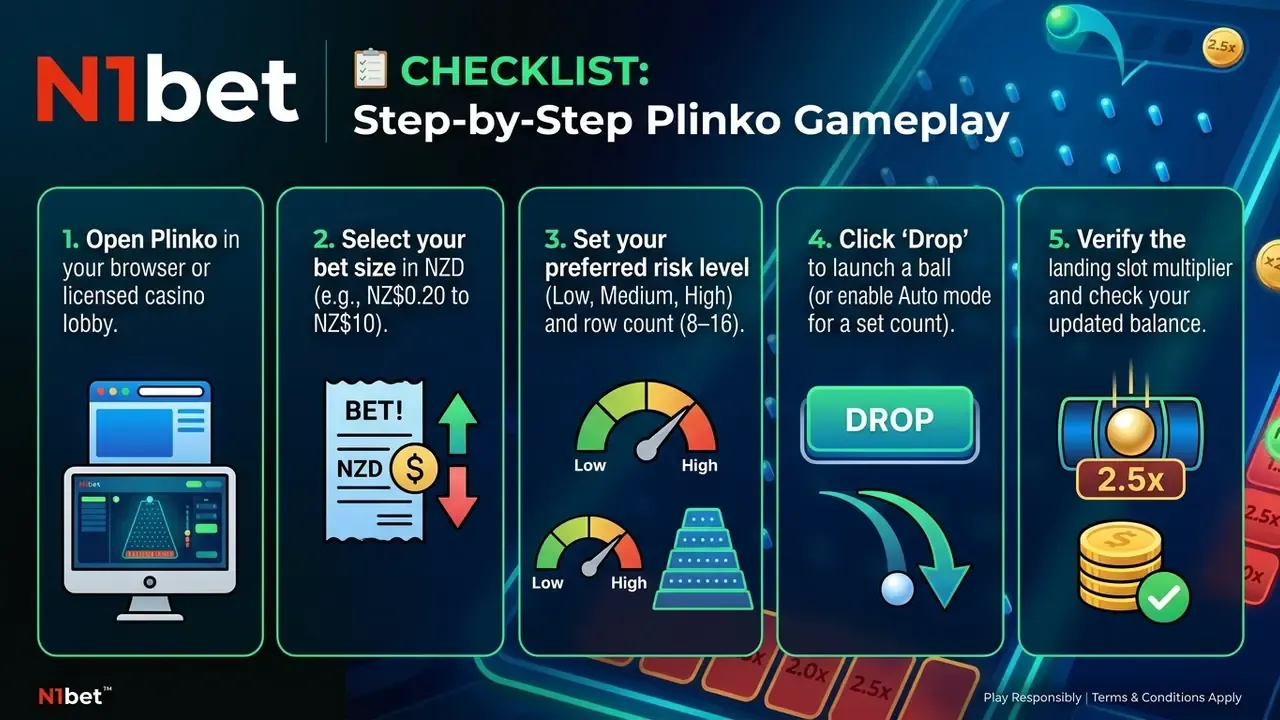
Playing Plinko online comes down to four moves: set the bet, choose risk level and row count, drop the ball, then read the landing multiplier against your balance.

Selecting Your Bet Size and Launching the Ball

Start by choosing a stake inside the operator's limits, often from NZ$0.10 up to NZ$100 per drop. Once the bet is locked, the launch button releases a ball from the top centre of the peg grid.

Most Plinko builds also include an Auto mode. It queues a set number of automated drops (10, 50 or 100 rounds, for example) at a fixed stake. Some variants allow simultaneous multi-ball drops, where several balls cascade at once and each is settled independently on landing. Manual mode keeps the pace in your hands. Auto mode hands pacing to the software, which is exactly why session limits matter more here than on a slower table game.

Selecting Your Bet Size and Launching

Adjusting Risk Levels and Board Row Count

The risk setting rewrites the multiplier values at the bottom of the board. It does not touch the 50/50 deflection physics of the pegs:

  • Low risk. Multipliers cluster near 1.0x. Central slots pay roughly 0.5x to 0.9x, and edge slots offer modest returns such as 8x to 16x. Variance is low and the balance moves slowly.
  • Medium risk. A middle setting: central returns trimmed to about 0.3x to 0.8x, edge multipliers lifted into the 80x to 150x range on larger boards.
  • High risk. The spread widens dramatically. Central slots may return as little as 0.2x, or 0x, which is a total loss of the stake, while edge multipliers climb to 555x or 1,000x.
  • Row configuration. Expanding from 8 to 16 rows lifts the number of terminal slots from 9 to 17. More rows spread the probability mass thinner at the edges, which is what lets developers publish those very large maximums on 16-row high-risk boards.

Spribe presents the same idea visually rather than numerically. You pick a green ball for the safest spread, yellow for balanced play, or red for maximum volatility, then set the pin count to 12, 14 or 16 rows.

Adjusting Risk Levels and Board Row

RTP, Volatility and Multipliers in Plinko

RTP and volatility are the two numbers that define the experience. Across major studios such as BGaming, Spribe and Hacksaw Gaming, published Plinko RTPs generally sit between 95% and 99%.

Risk LevelTypical RTP RangeMax Multiplier (16 Rows)Centre MultiplierVolatility and Gameplay Character
Low98.0% to 99.0%8x to 16x0.5x to 1.0xLow variance; frequent near-stake returns; steady, slow balance movement.
Medium96.0% to 98.0%80x to 150x0.3x to 0.8xModerate variance; broader payout swings; balance fluctuates noticeably.
High95.0% to 97.0% (up to 99% on select builds)555x to 1,000x+0.0x to 0.2xHigh variance; frequent zero or low returns; rare, large edge payouts.

How to Interpret RTP and Why It Doesn't Guarantee a Win

RTP is a long-run expectation calculated across millions of simulated drops. A Plinko game at 98% RTP carries a 2% house edge. Practically, for every NZ$100 wagered collectively by the whole player base over time, the game is built to return an average of NZ$98.

However, RTP is not a promise about your session.

Try the numbers on a small budget. Say you drop NZ$0.50 balls on a 97% RTP board for 400 rounds. Total turnover is NZ$200, and the theoretical cost of that entertainment is about NZ$6. Yet a real 400-drop run might finish NZ$40 up or NZ$70 down, because each drop is an independent event and variance dominates short samples. Actually, on High risk that spread gets wider still.

How to Interpret RTP and Why

«Wording such as “players lose on average £7 for every £100 wagered” produces higher comprehension than a percentage RTP figure, and reduces the urge to play.» Source: Newall et al., cited in the UK gambling reform white paper High Stakes: Gambling Reform for the Digital Age (2023).

Applied to Plinko, the translation is simple: a 97% RTP means the game is designed to keep about NZ$3 of every NZ$100 you wager, on average, over the very long run. Frame it that way before you deposit.

Volatility measures how widely payouts scatter around the average. Selecting High risk raises volatility without touching the peg geometry. To fund those huge edge multipliers, such as 1,000x on a 16-row board, developers push the central coefficients down to 0.2x or 0x.

Because the central landing positions absorb the large majority of drops under binomial probability, high-risk Plinko drains a bankroll quickly during ordinary play, offset only by very rare hits at the outer edges.

Volatility warning: on High risk, most drops return less than your stake. A run of dozens of cold drops is the statistically expected outcome, not a malfunction, and certainly not a sign that a big edge hit is “due”.

Top Online Plinko Game Variants Compared

Not every online Plinko uses identical mechanics. Beyond row counts, studios add bonus features, alternative risk interfaces and hybrid ideas borrowed from pokies:

  1. Spribe Plinko (RTP 97%). A three-tier visual risk system. You drop colour-coded balls: green for frequent low-multiplier hits, yellow for balanced payouts, red for high volatility with a 555x maximum on 16 rows. Pin counts are limited to 12, 14 or 16. Provably fair verification is included, with no bonus rounds or gamble feature.
  2. BGaming Plinko / Plinko XY (RTP up to 99%). One of the highest baseline RTPs on the market, maximums up to 1,000x, line counts from 8 to 16, three risk levels (low, normal, high) and Manual or Auto bet modes. A built-in record table logs recent results, and live hot-or-cold RTP insights let players review real-time payout performance. Themed spin-offs include Plinko 2, Plinko 2 Halloween and Football Plinko.
  3. Lollypop Plinko by Blitzcrown. Adds “spring slots” at the base of the board that catapult the ball back to the top, applying a 4x multiplier each time it re-enters play. A single ball can loop repeatedly, compounding value before it finally settles in a standard pocket.
  4. Olympus Plinko by Betsoft. Integrates a bonus prize wheel triggered when a ball lands in dedicated bonus slots, offering instant cash awards, multiplier boosts and progressive jackpot entries. Filling an on-screen counter unlocks an extra wheel spin. Betsoft also produces Plinko Rush, a cleaner 8 to 16 line build with adjustable volatility.
  5. PlinkoX by Smartsoft Gaming. Drops random high-value multiplier balls (up to 100x) alongside standard rounds, plus fast-resolve modes for high-frequency play.
  6. Hacksaw Gaming and Stake Originals builds. Customisable row grids, adjustable drop speed, cryptographic Provably Fair verification, alternative thematic skins and, on some crypto platforms, published ceilings well above 1,000x. Plinko Blitz (Dragon Gaming) takes a similar route with random multiplier balls and a “dead zone” that increases downside risk.
Top Online Plinko Game Variants Compared
Provider and TitleBaseline RTPRow RangeMax MultiplierKey Unique Feature
BGaming Plinko99.0%8 to 161,000xLive hot/cold stats, record table, highest market RTP
Spribe Plinko97.0%12, 14, 16555xGreen/yellow/red ball colour risk system
Blitzcrown Lollypop Plinko~96.5%8 to 162,000x+Spring pegs with 4x re-entry launch
Betsoft Olympus Plinko~96.2%8 to 16Jackpot-linkedBonus wheel trigger with progressive jackpots
Hacksaw / Originals Plinkoup to 98.0%8 to 163,843x+Adjustable drop speed, provably fair verification
Smartsoft PlinkoX~97.0%8 to 16100x bonus ballsRandom auto-dropped multiplier balls

RTP figures reflect provider-published data for standard builds. Operators sometimes deploy alternative RTP configurations, so check the in-game info panel before wagering.

Plinko Demo and Free Plinko: Why Play for Free?

Plinko demo mode is a practice setting funded with virtual credits. It lets you test the rules, board geometry and risk parameters without money on the line. Free Plinko runs on the same mathematical model and the same pseudorandom number generator as the cash version, so it works well as a tool for watching how multiplier layouts react when you change risk settings.

Features and Testing Tools in Plinko Demo

A free Plinko demo gives you several practical checks:

  1. Observing multiplier spreads. Toggle Low, Medium and High risk and watch central payouts shrink as edge multipliers inflate.
  2. Evaluating row counts. Move from 8 to 16 rows and see how sharply landing frequency falls away near the outer slots.
  3. Session pacing. Free play shows how fast automated drops consume a balance during high-frequency auto-play.
  4. Interface familiarity. Trying Manual against Auto mode, turbo settings and stop conditions before money is involved cuts down on expensive mis-clicks later.

«A study of 1,026 young adults found that participation in simulated gambling, including free casino-site demos, was associated with higher levels of gambling harm.» Source: Order of first-play in simulated versus monetary gambling, PubMed Central (Australian sample, ages 18 to 25).

Where to find the demo without an account: on provider portals and review pages, look for a “Play Demo” or “Play for Fun” button on the game tile or directly above the game window. It loads the HTML5 client with virtual credits and no sign-up form. Inside a casino lobby the same option usually appears as “Demo” or “Try” when you hover over the Plinko thumbnail. If only a “Play” button shows, that operator requires a logged-in account for the title.

Differences Between Demo Play and Real-Money Wagering

The visuals and the underlying RNG code are identical in legitimate builds. The experience is not. In demo mode nothing is at stake, and a depleted virtual bankroll refills with a page refresh. Real-money play attaches every drop to your actual balance, your withdrawal limits and your KYC-verified account. That is a very different decision environment, and it changes how a losing streak feels.

⚠️ ALERT: Responsible gambling and demo mode expectations Frequent edge hits in a free Plinko demo do not predict or guarantee results with real money. Plinko outcomes are strictly random. Empirical research indicates that simulated gambling can distort risk perception by stripping out the financial weight of losing streaks. Set personal deposit limits before you move from demo to cash play.

Survey data puts numbers on the link:

«54% of real-money online gamblers had previously played simulated gambling games; 17% of the entire sample believed simulated games led them to wager real money.» Source: Fiedler et al., Journal of Gambling Studies (2024), survey of 46,136 German internet users.

Plinko Real Money: Essential Factors Before Betting Cash

Disclaimer: This information is general in nature and does not replace professional advice. Real-money gambling carries financial risk. Play responsibly and strictly within your budget. If gambling is causing harm, free confidential support is available in New Zealand: Gambling Helpline 0800 654 655 or Problem Gambling Foundation NZ 0800 664 262.

Moving to real-money Plinko means checking the platform's licence, its NZD payment security, its bonus terms and your own limit settings. Because every drop touches your bankroll, operator safety outranks marketing copy. In practice that means confirming the licence, the payout policy and the identity-verification (KYC) requirements before your first deposit, not at the moment you try to withdraw.

How to Choose a Reliable Plinko Casino

When picking a licensed online casino for real-money Plinko, run five baseline checks:

«According to the New Zealand Gambling Survey 2023/24, 31% of adults participated in online gambling, and 3.6% used offshore platforms where Plinko is available.» Source: New Zealand Gambling Survey 2023/24, Ministry of Health / Strategy to Prevent and Minimise Gambling Harm 2025 to 2028.

  1. Valid licensing. Confirm an active licence from a recognised regulator, such as the Malta Gaming Authority or Curaçao, or compliance with New Zealand's evolving online gambling rules under the Department of Internal Affairs (DIA). Cross-check the licence number on the regulator's own public register and make sure the company name matches the one in the site footer.
  2. Independent RNG audits. Look for fairness certification from testing laboratories such as eCOGRA, iTech Labs or GLI, or cryptographic Provably Fair verification. RTP should be published in the game info panel and match the provider's official figure. Missing or hidden RTP data is an immediate red flag.
  3. Local banking and crypto options. Prefer operators with instant NZD deposits via Visa or Mastercard, Apple Pay and POLi, alongside major cryptocurrencies (Bitcoin, Ethereum, USDT, Litecoin). Crypto Plinko platforms in the Stake or Roobet mould let you verify outcomes through provably fair hashes, with settlement recorded on-chain rather than through a bank rail.
  4. Clear payout policies. Check daily and weekly withdrawal limits, the KYC document list, and whether the operator reserves the right to split large payouts into instalments.
  5. Responsible gambling tools. Self-exclusion, time-outs, reality checks and deposit limits should all sit inside the account dashboard, not behind an email request to support.
1. Valid licensing. Confirm an active

NZD Payment Methods and Typical Withdrawal Speeds

MethodCurrencyTypical Min DepositDeposit SpeedTypical Withdrawal TimeNotes
Visa / Mastercard debitNZDNZ$10 to NZ$20Instant1 to 3 business daysSome NZ card issuers decline gambling MCC codes
POLi (bank-to-bank)NZDNZ$10InstantDeposit only (payout via bank transfer)Popular local option; no card details shared
Bank transferNZDNZ$20 to NZ$501 to 2 business days2 to 5 business daysBest suited to larger withdrawals
Apple Pay / Google PayNZDNZ$10InstantDeposit onlyBiometric authorisation on mobile
E-wallets (Skrill, Neteller, MiFinity)NZDNZ$10Instant0 to 24 hoursOften excluded from welcome bonuses
Prepaid (Neosurf, Paysafecard)NZDNZ$10InstantDeposit onlyUseful for hard deposit caps
Crypto (BTC, ETH, USDT, LTC)Crypto~NZ$15 equivalent5 to 30 minutes10 minutes to 2 hoursNetwork fees and FX conversion apply

Figures above are typical market ranges published in operator cashier terms and reported by NZ-facing players. They vary by brand, verification status and payout queue, so confirm current limits, fees and processing windows on the specific site.

KYC speed matters more than payout speed. Most delays Kiwi players report are verification delays, not banking delays. Upload photo ID, proof of address and proof of payment method straight after registering, before you request a withdrawal. Most operators then clear documents within 24 to 72 hours.

Short answer: no New Zealand law penalises an individual adult for playing Plinko at an offshore online casino. The Gambling Act 2003 regulates the supply of gambling in New Zealand rather than criminalising the punter who plays on a website hosted overseas. What has shifted is the supply side. The Department of Internal Affairs has been progressing an online casino licensing regime intended to bring a limited number of licensed operators under domestic oversight, with harm-minimisation and advertising obligations attached.

Because that framework is still bedding in, treat any claim about “fully licensed NZ online casinos” with caution and verify the current position with the Department of Internal Affairs (dia.govt.nz) before depositing. [Regulatory status is evolving; confirm against current DIA guidance at the time you read this.]

Player-side legality checklist:

  • You are 18 years or older (many operators, and all NZ-facing content, require 18+).
  • The operator holds a verifiable licence you have checked on the regulator's register.
  • The site accepts New Zealand residents in its terms, not just NZD as a currency.
  • The cashier supports a payment method your NZ bank permits for gambling transactions.
  • Responsible gambling tools (deposit limits, time-outs, self-exclusion) are available in your account before you play.
  • You understand that winnings from recreational gambling are generally not taxed as income in New Zealand, while professional-scale activity may be treated differently. Seek independent tax advice if in doubt.
Is Plinko Legal in New Zealand

Casino Bonuses and Offers for Plinko

Welcome bonuses, deposit matches and cashback offers are everywhere. Applying them to Plinko is where the fine print bites.

Many operators assign lower wagering contribution rates to instant-win and arcade titles than to pokies, and some exclude Plinko from bonus play altogether. [Contribution weightings are operator-specific and not standardised across the market, so read the game-weighting table inside the promotion's terms.] If Plinko contributes only 10% toward wagering, an NZ$10 bet clears just NZ$1.00 of the required turnover.

Take a worked example. An NZ$50 match with a 40x turnover requirement, played on a 97% RTP Plinko variant, demands NZ$2,000 in total bets ($50 \times 40$). At a 3% theoretical house edge, the expected cumulative loss across that NZ$2,000 is about NZ$60, which is more than the bonus itself is worth. That single calculation explains why plain-English bonus maths belongs in every review.

Better-value alternatives for Plinko players include wager-free cashback, wager-free bonus drops, and seasonal tournaments that reward turnover with prizes instead of locking your balance behind a 40x requirement.

Casino Bonuses and Offers for Plinko

🔍 FACT CHECK: verification criteria for Plinko platforms

  • Licence status: verified on official regulator registers (MGA, Curaçao, DIA guidance).
  • RTP disclosure: explicitly published in the game info panel (95% to 99%).
  • Wagering weight: Plinko contribution rate stated clearly in promotional terms.
  • Data protection: SSL/TLS encryption active across cashier and registration pages.
  • Payout terms: withdrawal caps, instalment clauses and the KYC document list published before deposit.

Plinko Strategy: Managing Bets and Risk Exposure

Disclaimer: This information is general in nature. No strategy guarantees a win. If you notice signs of problem gambling, seek help: Problem Gambling Foundation NZ 0800 664 262 or Gambling Helpline 0800 654 655.

No betting system, pattern or sequence can shift the house edge or manufacture a win in Plinko. Ball trajectories come from certified pseudorandom number generators or cryptographic provably fair algorithms, so every drop is independent of everything before it.

Why Strategies Cannot Override Random Outcomes

Claims that progressive systems such as Martingale or D'Alembert can “beat” Plinko are mathematically false. Provably fair builds combine a server seed, a client seed and a nonce, hashed via SHA-256 or HMAC-SHA512. The method is documented in provably fair technical analyses (PayoutVerdict, 2026) and assessed within the RNG certification frameworks published by laboratories such as iTech Labs and eCOGRA.

The outcome path is generated the instant the drop begins. Progressive bet sizing changes how much you expose, never the negative expectation baked into the multiplier grid.

«Among players who combined simulated and real-money gambling, problem gambling was identified in 33% of cases, against 7% for those who played only for real money.» Source: Fiedler et al., Journal of Gambling Studies (2024).

Plenty of players import classic casino systems into Plinko. Here is how each one behaves, and where it breaks:

  • Martingale (doubling after losses). You double the stake after every drop that lands in a central slot paying under 1.0x, then reset once a drop pays.
    • Why it fails: central slots on High risk (roughly 0.2x to 0.5x) hit well over 60% of the time. Sub-1.0x streaks escalate stakes exponentially, NZ$1 to $2 to $4 to $8 to $16 to $32 to $64, and you meet the table ceiling or an empty balance long before a large edge multiplier arrives. Each drop stays independent, so the “due win” never becomes more likely.
  • Anti-Martingale (Paroli). You double after a winning drop, say an edge multiplier above 2x, and reset to base after a loss.
    • Why it fails: edge multipliers are rare and independent. Two consecutive high-multiplier hits on a 16-row high-risk board carry a probability below roughly 0.0015%, so the system mostly raises your stake right before variance punishes it.
  • Flat betting with a stop-loss and a +20% target. Fixed equal stakes, around 1% of the session bankroll, with a hard exit at +20% profit or -15% loss.
    • Verdict: it does not alter the 1% to 3% house edge. It is still the only approach here that reliably controls session variance, blocks emotional over-wagering and keeps losses inside a figure you chose while calm. Streamers who “stop at +20%” are describing discipline, not an edge.
  • Row and risk switching, plus “hot board” hunting. Rotating between Low and High risk after cold streaks, or chasing a board that just paid an edge multiplier.
    • Why it fails: record tables and hot/cold panels describe history. They hold zero predictive power over the next drop, because the RNG carries no memory between rounds.
Dissecting Popular Betting Systems in Plinko

Bankroll Rules and Loss Limits for Real Money Play

Strategy cannot buy an edge. Structure can still slow the damage:

  • Fixed stake sizing. Keep each bet small against the session budget, around 1% to 2% of the bankroll per drop.
  • Hard stop-loss. Decide the loss limit before the first drop (for example, stop if the balance falls NZ$30) and leave when it hits.
  • Take-profit target. Choose the balance at which you withdraw, say +20%, then actually process the withdrawal rather than recycling it into more drops.
  • No chasing. Raising stakes after a run of low central multipliers accelerates depletion. It does not recover anything.
  • Session time limits. Turbo auto-play can fire dozens of drops per minute, so a clock limit protects you better than a feeling of control.
  • Deposit limits, not willpower. Configure the operator's deposit limit tool at registration. A cap enforced by the platform beats an intention every time.
Bankroll Rules and Loss Limits for

Plinko Mobile and Plinko Download: Playing on Phone Devices

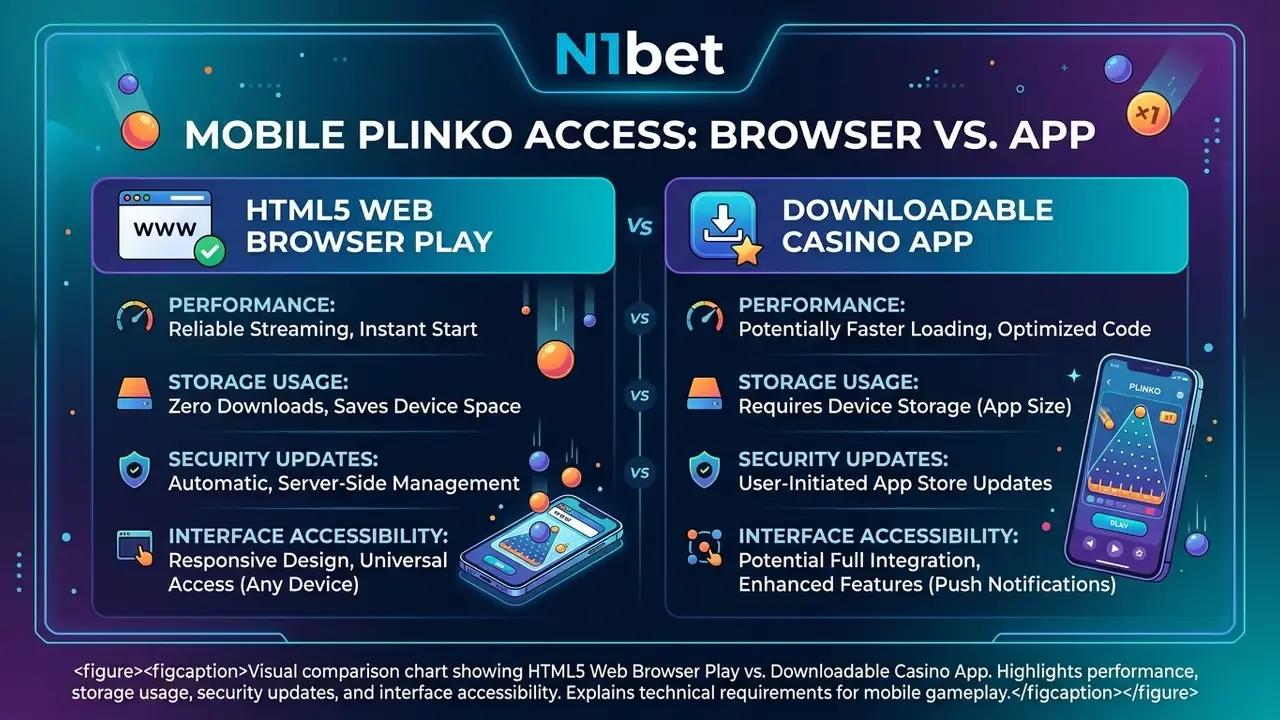
Most modern Plinko titles are built in HTML5 and published as browser-playable on desktop and mobile, so iOS and Android access needs no standalone app. [Compatibility statements come from provider game specifications; real performance still depends on your browser, OS version and connection.]

In-Browser HTML5 Gaming Versus Casino App Downloads

Kiwi players have two realistic mobile channels:

  • In-browser play (HTML5). Runs inside Safari, Chrome or mobile Firefox. No device storage needed, patches apply automatically, and you keep full access to risk settings and the cashier. Security leans on HTTPS and the browser's sandbox model.
  • Casino app downloads. Some licensed operators ship native Android or iOS apps through the official stores. Apps can load a touch faster and support biometric login (Face ID or Touch ID), but they consume storage, need manual updates and request extra device permissions, which enlarges the attack surface when update hygiene slips.
In-Browser HTML5 Gaming Versus Casino App

Technical Checks Before Launching Mobile Plinko

Five checks before you drop the first ball on a phone or tablet:

  1. Connection stability. A steady Wi-Fi or 4G/5G link prevents the interface freezing mid-drop. RNG outcomes are logged on server seeds, yet a dropout still interrupts visual feedback and rattles nerves.
  2. Screen orientation. Portrait usually beats landscape here, because the pyramid and the multiplier row fit a vertical screen without shrinking the payout labels. Lock rotation before an auto-play sequence.
  3. Data usage on auto-play. Long auto-drop runs stream continuous animation plus result calls, which eats noticeably more mobile data than a static pokie session. Use Wi-Fi for long sessions and switch off turbo if the signal wobbles.
  4. Interface calibration. Check that bet adjustments, row toggles and risk selectors respond cleanly on a small screen, with no accidental double-tap risk on the Drop button.
  5. Official sources only. Never install standalone .apk files or third-party executables from sites advertising “Plinko apps”. Reach Plinko through verified licensed casino portals or the official app stores, full stop.
Technical Checks Before Launching Mobile Plinko

FAQ About Plinko Game

How PlayWise NZ Reviews a Plinko Casino: The Five-Step Method

Ratings are only worth reading when the method behind them is visible. Every operator covered here goes through the same five steps, in the same order:
1
Licence verification. The licence number in the footer is checked against the regulator's public register, and the operating company name must match. If the register entry is missing, expired or registered to a different entity, the review stops there.
2
Bonus-terms audit. Wagering multiple, game weighting for instant-win titles, max bet during wagering, expiry window and maximum cash-out are all read in full, then converted into a plain-English figure in NZD.
3
Deposit and withdrawal review. Cashier terms are compared against reported processing times: minimum deposits, withdrawal caps, instalment clauses, fees and the KYC document list.
4
Responsible gambling tooling. Deposit limits, loss limits, time-outs, reality checks and self-exclusion must be reachable inside the account, not gated behind a support ticket.
5
Editorial sign-off. Numbers are cross-checked against provider documentation, and any figure that cannot be sourced is marked as unverified rather than smoothed over.
Red flags that end a review early: no visible licence number, RTP hidden from the game info panel, bonus terms that change between the landing page and the T&Cs, a cashier that pushes deposits while burying withdrawal steps, and countdown timers pressuring you to claim an offer. A trustworthy cashier is boring in the best way.

Key Takeaways for Kiwi Players

  • Plinko started as a 1983 segment on The Price Is Right, created by Frank Wayne, and was digitised for online casinos from 2019 by studios including BGaming and Spribe.
  • The game is pure chance, governed by binomial probability and either a certified RNG or provably fair hashing.
  • Published RTPs sit between 95% and 99%, yet short sessions swing hard. A 97% RTP means the game is built to keep about NZ$3 of every NZ$100 wagered over the long run.
  • Changing risk level and row count reshapes the multiplier table. It moves volatility, never the house edge.
  • Martingale, Anti-Martingale and “hot board” hunting cannot beat an independent-outcome game. Flat betting with a stop-loss manages variance, nothing more.
  • Check the licence, RTP disclosure, NZD payment options, withdrawal timelines and KYC requirements before depositing, and read the bonus game-weighting table, because a 40x wager on a 10% contribution game can cost more than the bonus is worth.
  • PlayWise NZ assesses platforms with a neutral five-step method (licensing, bonus terms, deposit and withdrawal review, safety tools, editorial sign-off) to keep the facts in plain English.
  • Play responsibly. Set deposit limits, use self-exclusion when you need it, and keep every session inside a budget you decided in advance.

If Plinko still appeals after all of that, start in the free demo, set your limits first, and treat any real-money session as paid entertainment.

Key Takeaways for Kiwi Players

Support Resources in New Zealand

  • Gambling Helpline NZ: 0800 654 655 (free, 24/7) or text 8006.
  • Problem Gambling Foundation NZ (PGF Services): 0800 664 262, free counselling and family support.
  • Department of Internal Affairs (DIA): the gambling regulator for New Zealand and the primary source on the current legal status of online casino play.
  • Gambling is restricted to adults aged 18+. Gambling can be addictive. If it stops being entertainment, stop playing and reach out.