Last updated: 2026 | Audience: New Zealand readers researching the Balloon crash game | Reading time: ~14 minutes
Balloon: Play the Demo Free or for Real Money — Complete 2026 Guide
Provider
SmartSoft Gaming
RTP
95.598.0%
Volatility
Medium
Min bet
€0.10
Max bet
€100
Max win
10,000x

Quick Overview: Balloon by SmartSoft Gaming
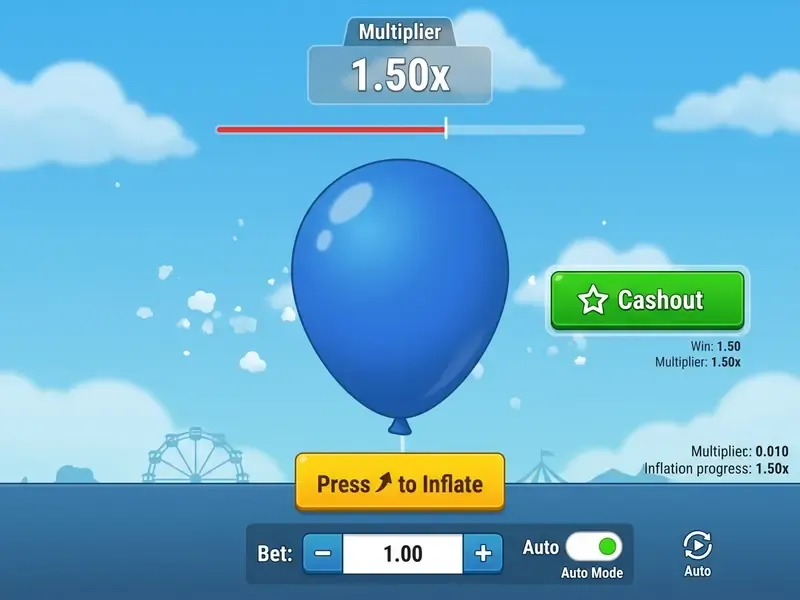
Balloon is an instant-win crash game from SmartSoft Gaming, released in 2022. Unlike classic crash titles such as Aviator or JetX, where you tap a single cash-out button, Balloon uses a press-and-hold mechanic. You hold the pump button to inflate the balloon, the multiplier climbs, and you release before it pops. Let go too early and you bank a small win. Hold too long and the round is gone.
The Balloon demo is the free-play version of that same game. It runs on the identical maths model and RNG engine, but uses virtual credits instead of your own money. No registration, no deposit, no download.

⚠️ Important disambiguation: Do not confuse the SmartSoft Gaming casino game Balloon with the Pymetrics Balloon Game, a psychometric recruitment assessment used by employers such as Accenture and Bain. If you arrived here looking for the hiring test, skip ahead to the Pymetrics section further down. It is covered in detail, so you do not have to go back to the search results.
Balloon technical specification
| Parameter | Value | Note |
|---|---|---|
| Provider | SmartSoft Gaming (Smartsoft Limited) | Company registration C 99015; not Spribe, a common error on free-play aggregator sites |
| Licence | MGA/B2B/925/2021 | Licensed and regulated B2B entity, Malta Gaming Authority; registered at Level 3 (Suite 2746), Tower Business Centre, Tower Street, Swatar, Birkirkara, Malta. Curaçao-compliant distribution also referenced by operators |
| Release date | 2022 | Instant-win / crash genre |
| Game type | Crash game (no reels, no paylines, no rows) | Player-controlled cash-out |
| RTP | 95.5% – 98.0% | Configurable band; the realised return depends on operator configuration and on when the player banks |
| Volatility | High | Risk is effectively set by the player |
| Maximum multiplier | 10,000× | Theoretical ceiling |
| Bet range (example market) | 350 – 175,000 ARS | Operator- and currency-dependent; max win 1,750,000 ARS in that configuration |
| Signature mechanic | Press-and-hold pump | Direct, continuous control instead of one-tap cash-out |
| Jackpot | Not available | — |
| Auto features | Autoplay, auto cash-out, adjustable game speed | Available in demo and real-money modes |
| Engagement tools | Leaderboard, Missions Promotion, Prize Drop, Coin Flip | B2B retention modules enabled by the operator |
| Platforms | HTML5 browser (desktop, tablet, mobile) | No download required |
Why this guide matters for New Zealand players
Most "Balloon demo" pages read like a landing page with a spin button. This one is built the way PlayWise NZ builds every review: method first, marketing never. You get the maths, the licensing trail, the risks, and the parts free-play sites quietly skip.
Here is what is inside: the full specification table above, four fully specified play patterns with the arithmetic behind them, a demo-versus-real-money comparison, a licensing and safety checklist, mobile and download guidance, and a research section on simulated gambling that almost nobody publishes next to a demo window.
The guide is written for readers in New Zealand, where online casino regulation is shifting fast. It deliberately avoids promotional language. No "immerse yourself in a world of adventure". Only figures, mechanics and sourced findings.

Disclaimer: This information is general in nature and is not a substitute for professional advice. Real-money play is gambling, is restricted to adults (18+) in regulated jurisdictions, and may be limited or prohibited where you live. If you are struggling to control your gambling, contact a specialist support service. In New Zealand, the Gambling Helpline is available on 0800 654 655.
What Balloon game is and how the game works
In two sentences: Balloon runs a multiplier upward from 1.00× until a randomly determined crash point, and your only decision is when to release the pump. That single decision, not any pattern, colour or "hot streak", determines your outcome in every round.
Balloon as an online crash game
In crash-format games, the wager is placed before the round begins, and a multiplier increases until a random crash point ends the round. Cash out before the crash and your stake is multiplied by the displayed value. Miss it and the stake is lost.
Slots resolve on a fixed spin and roulette on a single wheel result, whereas crash games resolve in real time. That is why Balloon feels like a skill game even though the crash point is pre-determined by the random number generator at the start of the round. It is the same reason balloon games and other casino games sit in different mental boxes for most players, despite sharing the same house-edge logic.
The mathematics here are unusually transparent. For a player who commits to a fixed exit multiplier, expected value is flat across every possible target:

«For a player choosing a fixed exit multiplier t, expected return equals t × (0.97/t) = 0.97 — a constant 3% loss regardless of strategy.» — Dubach, Gambling Fairness Paradox (2026)
That single line is the most important fact on this page. Whether you release the pump at 1.2× or hold for 50×, the long-run expected return is identical. Only the shape of the variance changes. Note that Balloon's published RTP band is 95.5%–98.0%, so the house edge in practice sits between 2% and 4.5% depending on operator configuration, slightly wider than the 3% used in the worked example.
Crash platforms that publish provably fair data can be tested empirically, and independent analysis supports the declared random process rather than a manipulated one:
«Kolmogorov–Smirnov tests showed statistically insignificant deviations: the estimated parameter α ≈ 1.98 against a theoretical value of 2.» — Dubach, Gambling Fairness Paradox (2026)
Put plainly: the multipliers generated by a correctly implemented crash engine match the distribution the operator declares. Under a provably fair scheme, a server seed, a client seed and a nonce allow each round to be verified after the fact, so the result cannot have been substituted once the bet was placed. That design principle is set out in independent testing-laboratory documentation (iTech Labs). Randomness itself is a standards question. RNG output is defined by NIST as the generation of unpredictable bits, which means individual outcomes cannot be forecast. And RTP, as treated in eCOGRA/GLI documentation, is a long-run theoretical average rather than a promise about your session.

When a Balloon round ends
The crash multiplier M is effectively determined by a random draw from a heavy-tailed distribution, and the practical consequence is a simple survival curve:
«The survival function P(M ≥ m) = 0.97/m means: exiting at 1.5× succeeds in ~64.7% of cases, at 10× in only ~9.7%.» — Dubach, Gambling Fairness Paradox (2026)
Applying the same formula to the exit points players actually use:
| Target exit | Approximate success rate | Expected return per unit staked |
|---|---|---|
| 1.20× | ~80.8% | 0.97 |
| 1.40× | ~69.3% | 0.97 |
| 2.00× | ~48.5% | 0.97 |
| 3.00× | ~32.3% | 0.97 |
| 5.00× | ~19.4% | 0.97 |
| 10.00× | ~9.7% | 0.97 |
| 100× | ~0.97% | 0.97 |
On the "crash colour logic" claim. Aggregator sites frequently state that operators change the balloon's colour at multiplier thresholds, or display previous crashes in red and green so players can "read" the next round. What can actually be verified is narrower. Many crash interfaces, including Balloon implementations, show a history strip of past round results and use colour to encode magnitude.
That history is a record of independent past draws. Nothing more. It has no predictive value for the next round, because each crash point is generated independently. Any strategy built on the colour strip is pattern-seeking dressed up as analysis.
Visual and auditory feedback is not neutral, though. It is used deliberately to reinforce engagement, and it shapes how risk is perceived:

«Adolescents described gambling-like games through "atmosphere" and visual cues rather than probabilities — design shapes risk perception.» — Hing et al., qualitative interviews with 89 Australian adolescents aged 12–17 (2023–24)
The inflating balloon, the rising pitch, the pop. These are design choices that make a 19.4% event feel attainable and a 3% edge feel negotiable.

The press-and-hold mechanic in practice
A single Balloon round proceeds in five stages:
- Stake selection. Set your bet amount and, if the operator enables dual wagers, a second stake.
- Round launch. The round begins and the crash point is already fixed by the RNG.
- Inflation. You press and hold the pump. The balloon expands and the multiplier climbs. Holding is a continuous action, which is why Balloon feels more tactile than one-tap crash games, and why hesitation costs more here than in Aviator-style titles.
- Release (cash-out). Releasing banks stake × current multiplier. Auto cash-out releases for you at a pre-set value.
- Round end. Either your win is credited, or the balloon pops and the stake is lost. The result is appended to the history strip.

Balloon demo: how to play free
In two sentences: The demo is the same game with the money switched off, and that makes it a genuinely useful test bench. Just not a rehearsal for profit.
What Balloon demo mode actually gives you
Free play is a safe learning ground for four narrow but real tasks:
- Learning the game rhythm. Rounds last seconds. Press-and-hold timing is muscle memory, and it takes maybe 30 rounds before releasing at 1.35× stops feeling like a guess.
- Testing your understanding of crash mechanics. Log 100 rounds at a fixed target and compare your hit rate with the survival table. Most people are surprised by how ordinary a six-loss streak is.
- Checking platform behaviour. Does the round drop when your phone switches from Wi-Fi to mobile data? Better to find out on virtual credits.
- Practising decisions, not predictions. The demo can train discipline around exits. It cannot train prediction, because there is nothing predictable to learn.
One honest caveat, and it belongs here rather than in a footnote: a "bankroll" you cannot lose invites hold times you would never attempt with your own money. That is the demo's main blind spot.

How to launch the Balloon demo game
The sequence is short. Play balloon in free mode like this:
- Open a licensed casino or a provider-hosted game page in your browser.
- Find Balloon in the crash or instant-win category, not in the pokies lobby.
- Select Demo or Play for fun instead of the real-money button.
- The game loads with virtual credits, usually a fixed practice balance.
- Set a stake, hold the pump, release. Instant access, no account, no download.
If a site refuses to show you demo balloon before you deposit, treat that as a signal about the site rather than about the game. A legitimate operator has no reason to hide free play.


Demo play and simulated gambling: what the research says
In two sentences: Free-play crash games belong to a category researchers call "simulated gambling", and the evidence links engagement with that category to later monetary gambling and to elevated problem-gambling scores. This is the section free-play sites leave out.
Definitions and taxonomy
A literature review commissioned by the Australian Institute of Family Studies and related bodies defines simulated gambling in broad terms:
«Simulated gambling includes social casino games, demo versions and loot-box games — structurally identical to gambling, but outside the legal definition.» — Literature review commissioned by the Australian Institute of Family Studies (2023)
The key phrase is structurally identical. A Balloon demo reproduces the stake, the odds, the volatility and the feedback loop of the paid product. It removes only the money.
Simulated and real-money play are not separate populations. In a large German sample:
«Among 5,191 online real-money gamblers, 54% had also engaged in simulated gambling — the formats coexist within one person's repertoire.» — Weber et al., Journal of Gambling Studies (2024); drawn from 46,136 German internet users
Younger users tend not to categorise these products as gambling at all. In qualitative interviews, one participant described a simulated product as something that "doesn't give off the gambling vibes… it just feels like a game":
«89 Australian adolescents aged 12–17 did not perceive simulated games as "real gambling" — the absence of money masks the structural similarity.» — Hing et al., qualitative study (2023–24)
Empirical evidence on transitions
Adolescents who engage in simulated gambling in the past month are consistently more likely to have gambled for money:
«Across both samples (816 adolescents aged 12–17), playing demo games on operator websites was associated with participation in all forms of monetary gambling.» — Derevensky et al., open access (2022–23)
Lifetime engagement in simulated gambling forms, with the notable exception of free loot boxes, is associated with lifetime and past-12-month monetary gambling, and with measurable harm indicators:
«Among 1,118 young people aged 12–17, lifetime participation in simulated gambling was associated with higher PGSI scores and self-reported gambling problems.» — Russell et al., International Journal of Behavioral Addictions (2023)
Adults report the sequence explicitly:
«54% of problem gamblers were "confident" that simulated games led them to real-money betting — against 17% in the overall sample.» — Weber et al., Journal of Gambling Studies (2024)
Harms and risk factors
The prevalence gradient is stark. In the German data, 33% of individuals who engaged in both simulated gambling and real-money gambling met criteria for problem gambling, compared with 7% of those who engaged only in real-money gambling. The association survived statistical control:
«After adjustment for sociodemographic variables, engagement in both formats still predicted significantly higher gambling frequency and problem gambling.» — Weber et al., Journal of Gambling Studies (2024)
None of this means a demo session is harmful in itself. It means the demo is not a neutral training tool. It is the entry point of a funnel, and the research documents where that funnel leads for a meaningful minority of users.
So use free play the way an analyst would. Test the survival table, verify platform stability, confirm that the maths is unfavourable. Not as a rehearsal for profitable play.
The psychology of cash-out features
In two sentences: Cash-out controls give players a genuine sense of agency, and experiments show that this sense of agency increases how much they stake. Balloon's press-and-hold design maximises exactly that feeling.
Why perceived control matters in Balloon
Balloon's core loop is built on the illusion that timing is skill. The crash point is fixed before you touch the pump. Your input changes only when you exit a pre-determined round, not the outcome distribution. Yet the physical act of holding a button while a number climbs produces a much stronger sense of authorship than pressing "spin".
Experimental evidence on cash-out options
Controlled research on cash-out mechanisms in wagering found that availability of a cash-out button increased participants' mean bet amounts by up to 35% in the strongest condition. The effect replicated under stricter conditions:
«In pre-registered Experiment 2 (between-subjects, 240 participants), the cash-out group staked on average 24% more than the control group.» — Bennett et al., Psychological Science (2024)
Two figures, two designs: up to 35% in the initial condition, 24% in the pre-registered between-subjects replication. The direction is consistent. A control that feels protective functions as a stake amplifier.
Practical implication for Balloon: auto cash-out genuinely reduces execution error, but it can simultaneously encourage larger stakes because the exit feels "guaranteed". If you use auto cash-out, freeze your stake size before the session and do not adjust it upward mid-session.
Balloon free and Balloon real money: how the modes differ
In two sentences: The demo replicates the engine, the RTP band and the interface, but not the incentive structure or the promotional layer. Results in one mode do not transfer to the other.
Functional differences between demo and real-money modes
Free play needs no account, no KYC and no deposit. Real-money access is legally restricted to adults in regulated jurisdictions and requires identity verification, which is why comparison and access should start with licensed online casinos rather than whatever demo window loads fastest.
| Criterion | Demo mode (Balloon free play) | Real-money mode |
|---|---|---|
| Financial risk | 0% — virtual credits | Full risk of losing deposited funds |
| Registration / KYC | Not required | Mandatory at a licensed casino |
| Engine and maths model | Identical RNG and maths model | Identical RNG and maths model |
| RTP | 95.5%–98.0% (as configured) | 95.5%–98.0% (as configured) |
| Winnings | Cannot be withdrawn | Withdrawable, subject to terms |
| Promotional layer | Usually unavailable | Leaderboard, Missions, Prize Drop, bonuses |
| Balance top-up | Reload the page / auto-refill | Deposit via payment methods |
| Psychological pressure | Low — no loss consequence | High: loss aversion, chasing, arousal |
| Age restriction | Varies by site; still an 18+ product | Strictly 18+ in regulated markets |
In plain text, for anyone reading on a narrow phone screen: demo mode costs nothing, risks nothing, pays nothing and hides the promotional layer. Real-money mode requires a verified account, exposes your deposit to full risk, pays withdrawable winnings under the operator's terms, and unlocks leaderboards, missions and bonuses. The engine and the RTP band are the same in both. The pressure on your decisions is not.
Why demo results do not predict real-money results
Demo play removes monetary consequence, and monetary consequence is precisely the variable that changes decision-making. Research on gambling decision-making shows that risk-taking is altered by stake size, loss aversion and emotional arousal once real money is involved. Two further technical points matter:
- Simulated credit does not reproduce the incentive structure of funded play. A balance you cannot lose invites hold times you would never attempt with your own money.
- Regulated product documentation distinguishes test and simulated environments from live money operation, so configuration and available features can differ between modes.
Stated in compliance terms: demo-mode outcomes are simulation only and do not guarantee winnings or performance in real-money play.

Disclaimer: Real-money play is available only to adults (18+) and depends on the laws of the country where you are located. Demo-mode results do not guarantee any outcome in real-money play.
Balloon game features: cash-out, two bets and session tracking
In two sentences: Three features do most of the practical work in Balloon, and all three are available in the demo. Used properly, they turn a game's tempo into something you can measure.
Auto cash-out and controlling the exit
Auto cash-out lets you nominate a target multiplier, say 1.35×, and the game banks automatically when the multiplier reaches it. It removes reaction-time error, which is the single largest source of avoidable loss in a hold-based game.
What it does not do is remove the house edge. And it cannot execute if the crash occurs before your target. Set the value, then leave it alone. Nudging a target upward mid-session is how a scalping plan quietly becomes multiplier hunting.
Adjustable game speed and autoplay sit alongside it. Both increase round throughput, which means faster exposure to the same negative expectation. Speed is a convenience feature, not a strategy.

Two-bet simulation and session tracking
Two-bet simulation, where the operator enables two simultaneous stakes, allows a hedged structure. One stake on auto cash-out at a low multiplier recovers most of the round cost; the other is held manually for a larger multiplier. This changes variance, not expectation. Worth repeating, because the hedge feels safer than it is.
Session tracking is where demo play earns its keep. Unlimited rounds let you log 100+ outcomes and test whether your intuition matches the survival table above. It almost never does.
Operator engagement tools built into Balloon
SmartSoft supplies Balloon to operators with a set of retention modules. Recognising them as commercial design, rather than player benefit, is part of reading a casino honestly:
- Leaderboard ranks players by wins or multipliers over a period, adding social competition to a solitary game.
- Missions Promotion sets task-based objectives ("cash out above 5× three times") that encourage play patterns you would not otherwise choose.
- Prize Drop Promotion allocates prizes randomly across a pool of active players during a campaign window.
- Coin Flip is a fast side mechanic that increases round throughput.
In most implementations, the demo build exposes core gameplay but not the promotional layer. Leaderboards, missions and prize drops are typically tied to a funded account.

Balloon strategy: using the demo to train decisions
In two sentences: Four structured patterns cover almost everything players actually do in Balloon, and each one is defined below with its success probability and staking rule. None of them changes expected value; they change variance, session length and how quickly a bankroll can disappear.
Early exits, middle multipliers and long holds
- Method:auto or manual cash-out at 1.20× – 1.40×.
- Maths:under a 97% model, ~80.8% of rounds reach 1.20× and ~69.3% reach 1.40×. Frequent small wins, occasional stake-sized losses.
- Reality check:at 1.20×, a single loss wipes out five consecutive wins. The pattern feels like a system because losses are rare, not because it profits.
- Suits:beginners learning the rhythm and the release timing.

2. Moderate exits (balanced variance)
- Method:bank between 2.00× and 3.00× (~48.5% and ~32.3% success respectively).
- Rule:if the balloon pops twice in a row below 1.50×, skip the next round or reduce the stake step. This is discipline, not edge.
- Suits:players testing whether medium multipliers feel manageable before committing money.

3. Multiplier hunting (high risk)
- Method:hold for 5.00×+ (~19.4% success) or beyond.
- Bankroll rule:stake no more than 1–2% of the notional balance per round. At 19.4% success, runs of eight or more consecutive losses are ordinary, so a 1% stake gives roughly 100 attempts of headroom.
- Warning:longer holds concentrate loss into streaks. The literature associating high-volatility products with more intense loss-chasing episodes among vulnerable players comes primarily from slot research. Transfer to crash games is plausible but not directly established, so read it as a caution rather than a proven finding for Balloon specifically.

4. Two-parameter test (paired-risk simulation)
- Method:play 10 rounds with auto cash-out fixed at 1.30×, then 10 rounds holding to 4.00×. Where dual wagers exist, run both simultaneously: bet A auto-banks at 1.40×, bet B is held manually above 3.00×.
- Purpose:record both sets in a table (see Appendix) and compare hit rate, net result and drawdown against the theoretical survival rates. Change one variable per session only.
- Outcome you should expect:both columns converge toward the same negative expectation, with wildly different volatility. That is the lesson.

Why the demo does not guarantee real-money results
There is no exit multiplier, sequence, colour reading or staking pattern that overcomes a fixed house edge in a game with independent rounds. The reason is the identity quoted earlier: expected return equals the RTP for every fixed exit target.
Betting systems, whether Martingale, d'Alembert, Fibonacci or their variants, redistribute the timing of losses rather than removing them. This is a long-standing conclusion in the mathematics of casino games, not a claim from a single paper. Because each Balloon round is an independent draw and the payout is proportional to the multiplier, doubling after a loss increases the size of the eventual loss without altering the per-round expectation. Table limits, bankroll limits and the geometry of losing streaks do the rest.
Treat any source promising a "guaranteed" Balloon system as marketing. Direct experimental literature on staking systems in crash games specifically is still thin, and more data would be needed to say much more than that.
What strategy can do:
- control session length and volatility,
- cap maximum loss per round,
- remove reaction-time errors (auto cash-out),
- make outcomes measurable, so you can compare them with the survival table.
What it cannot do: produce a positive expected return. Demo results, however clean they look, carry no promise into a funded account. The goals of the two modes differ, and so does the pressure on your judgement.


Fact check: Balloon strategies do not override the random nature of crash mechanics and cannot deliver guaranteed profit. Every round's crash point is generated independently by the RNG before your first pump.
A bankroll framework you can actually apply
- Decide the total amount you are prepared to lose before loading the game, and treat it as an entertainment cost.
- Set per-round stake at 1–2% of that amount for high-multiplier play, up to 5% for 1.2×–1.4× scalping.
- Set a stop-loss (say 30% of the session bankroll) and a stop-win, then use the operator's deposit and loss limits to enforce them rather than relying on willpower.
- Log every round. Unlogged sessions are remembered selectively: near-misses feel like skill and wins feel like proof.
- Never increase stakes to recover losses. Chasing is the single most reliable predictor of a bad session becoming a bad month.

Balloon online on mobile: browser access and download
In two sentences: Balloon runs in HTML5 on any modern browser, which is exactly what makes it high-risk from a harm perspective. Instant, private, always-available access cuts both ways.
Balloon mobile: playing from a smartphone
Mobile wagering has been associated with increased betting participation and frequency, higher expenditure, a wider variety of bet types and greater impulsivity. Qualitative work with young adults describes the mechanism directly:
«Smartphones have become the primary betting device in several countries, providing instant access and prompting impulsive bets in response to social cues.» — Hing et al., grounded theory study, young adult Australians (2024)
For Balloon specifically, the mobile build adapts touch controls so the pump responds to a sustained press on the screen. Rounds last seconds, load times are short, and the game fits comfortably into idle moments at a bus stop. The demo works the same way on a phone, which makes balloon play on mobile a reasonable place to test timing before any deposit.
One practical note on small screens: a sustained press competes with the browser's own gestures. Test a few demo rounds before assuming your grip translates to a funded round.
When Balloon download is needed, and when the online version is enough
Browser (HTML5) versus app is a practical choice, and for most players the browser wins.
- Online in-browser: no installation, no permissions, no storage cost. Demo balloon is available this way too, which is the fastest route to a risk-free test.
- Balloon download via a casino app: APK on Android or App Store distribution on iOS installs a separate client with its own update and permission model. It can offer smoother performance and push notifications, and those notifications are precisely the harm-minimisation problem.
From a harm-minimisation standpoint, the browser route is easier to walk away from. There is no icon on your home screen at 11pm. Note that Balloon itself never requires a download; any "Balloon download" you find is a casino client or, worse, a clone.

Harm-minimisation features and which ones work
Not all responsible-gambling tools work the same way for the same people. Research on mobile gamblers found that indirect tools protect well-being by breaking the negative relationship between heavy engagement and harm. High engagement combined with reality checks and account statements interrupts that link. The effect is differentiated:
«Direct tools (deposit limits, self-exclusion) are effective for harmoniously engaged players; indirect tools (reminders, account history) work for obsessively engaged players.» — Information & Management (2024); sample of mobile gamblers playing ≥3 days per week
Practical takeaway: set deposit and loss limits at registration, and switch on reality checks and account statements. If limit-setting feels intolerable, that reluctance is itself information worth acting on.
How to choose a Balloon casino for real-money play
In two sentences: The game is the same everywhere; the operator is not. Licensing, payout behaviour and bonus terms are where the real differences sit.
New Zealand's online casino regulatory context
Offshore gambling revenues reported to Inland Revenue have grown rapidly since 2016/17, reaching $342.5 million, and the risk profile of the players involved is not marginal:
«Among 156,000 adults gambling with offshore providers, 21.8% are moderate- or high-risk gamblers, with a further 21.2% at low risk.» — New Zealand Gambling Survey 2023/24; NZ Ministry of Health Strategy 2025–28
As New Zealand moves toward a domestic online casino licensing regime, casinos licensed under that system should be preferred over offshore sites. Licensed operators are accountable for age verification, self-exclusion, complaint handling and harm-minimisation tooling. Practical guidance on choosing a licensed casino is worth more than any Balloon tactic.
Checklist before you move from demo to real money
- Licence and jurisdiction —named regulator, published licence number, visible complaints route. No licence, no play.
- Software authenticity —Balloon should be supplied by SmartSoft Gaming (MGA/B2B/925/2021). Clones and "Balloon-like" imitations exist.
- Fairness documentation —published RNG testing or independent certification, with scope and date.
- Demo availability —a legitimate balloon casino lets you open the free version before depositing.
- Bonus terms in plain numbers —wagering multiple, contribution of crash games (often 0% or capped), max bet while wagering, expiry window. Many bonuses exclude Balloon entirely.
- Payments and withdrawals —stated methods in NZD, limits, verification requirements and processing times, read before your first deposit.
- Player protection tools —age verification, deposit, loss and time limits, reality checks, self-exclusion, all available inside the account area.
- Mobile support —responsive HTML5 build that does not drop rounds on connection changes.
- Payout speed —request a small withdrawal before scaling deposits. PlayWise NZ documents its operator testing method openly in the iGaming research hub, so you can judge a rating before you trust it.


Looking for the Pymetrics Balloon Game (hiring assessment)?
- Format:39 rounds. Each round presents a deflated balloon in one of three colours. Every pump adds $0.05 to the round's pot; you may bank at any time, but if the balloon bursts you lose that round's earnings.
- What it measures:risk-taking and learning. Balloon colours carry different burst probabilities, so a methodical candidate can update behaviour across rounds. That adaptation is the "learning" signal.
- Candidate averages (from a published sample of 500+ test-takers):24–25 balloons banked out of 39, about $18 total, completion time around 4 minutes.
- Max Money profile (adventurous):roughly 18–19 balloons banked, $20–$23 earned.
- Max Balloons profile (cautious):roughly 30–31 balloons banked, $17–$18 earned.
- Key point:there is no universal "good score". A good result matches the candidate profile the role is screening for, so read the job advert and the employer's stated values before choosing an approach.

Note the structural contrast with the casino game. In the Pymetrics test, burst probabilities differ systematically by colour and can be learned. In SmartSoft's Balloon, crash points are generated independently by an RNG and cannot be learned. Transferring tactics from one to the other is a category error.
Balloon FAQ
Conclusion
Balloon is a well-built, high-volatility crash game with an unusually tactile mechanic and an unusually transparent mathematical structure. Its demo mode is genuinely useful for three specific tasks: learning the press-and-hold timing, checking whether a platform loads and behaves reliably, and, most valuably, verifying with your own log of 100+ rounds that the survival table is accurate and that every exit target carries the same negative expectation.
What the demo cannot do is make you a profitable player, because no exit multiplier or staking pattern changes a 2%–4.5% house edge. The evidence base is also clear that simulated gambling is not a neutral sandbox: engagement with demo-style products is associated with monetary gambling participation and with elevated problem-gambling scores, and the presence of a cash-out control measurably increases how much people stake.
So read the specification table, set your limits before you load the game, prefer licensed operators, and treat any result, good or bad, as entertainment rather than income. If you want to compare casinos on facts instead of banners, start with the licensing and payout criteria above. Then play within the limits you set.

Disclaimer: This information is general in nature and is not a substitute for professional advice. Gambling involves financial risk; no strategy guarantees a profit. 18+ only. If gambling is causing harm to you or someone you know, contact the Gambling Helpline New Zealand on 0800 654 655.
Appendix: session log template and glossary
Session log (copy into a spreadsheet)
| Round | Stake | Target exit | Actual exit / crash | Result (±) | Running balance | Note |
|---|---|---|---|---|---|---|
| 1 | 1.30× | auto cash-out | ||||
| 2 | 1.30× | |||||
| … | ||||||
| 11 | 4.00× | manual hold | ||||
| … |
How to use it: run 10 rounds at one target, 10 at another, and compare your hit rate against the theoretical values (1.20× ≈ 80.8%, 1.40× ≈ 69.3%, 2.00× ≈ 48.5%, 3.00× ≈ 32.3%, 5.00× ≈ 19.4%, 10× ≈ 9.7%). Change one variable per session. Record stop-loss and stop-win before you begin.
Glossary
- Crash game —format in which a multiplier rises until a randomly determined end point; the player must bank before it occurs.
- Press-and-hold —Balloon's input method: a sustained press inflates the balloon and drives the multiplier.
- Auto cash-out —pre-set exit multiplier executed automatically by the game.
- RTP (return to player) —theoretical long-run percentage returned to players across a very large number of rounds.
- Volatility —the spread of outcomes around that average; high volatility means larger swings in both directions.
- Provably fair —verification scheme using server seed, client seed and nonce so a round's result can be checked after the fact.
- Survival function —probability that the crash multiplier equals or exceeds a chosen value, here approximated by RTP ÷ m.
- PGSI —Problem Gambling Severity Index, a standard screening measure used in the studies cited above.
- Simulated gambling —social casino games, demo modes and loot-box products that are structurally like gambling but fall outside its legal definition.