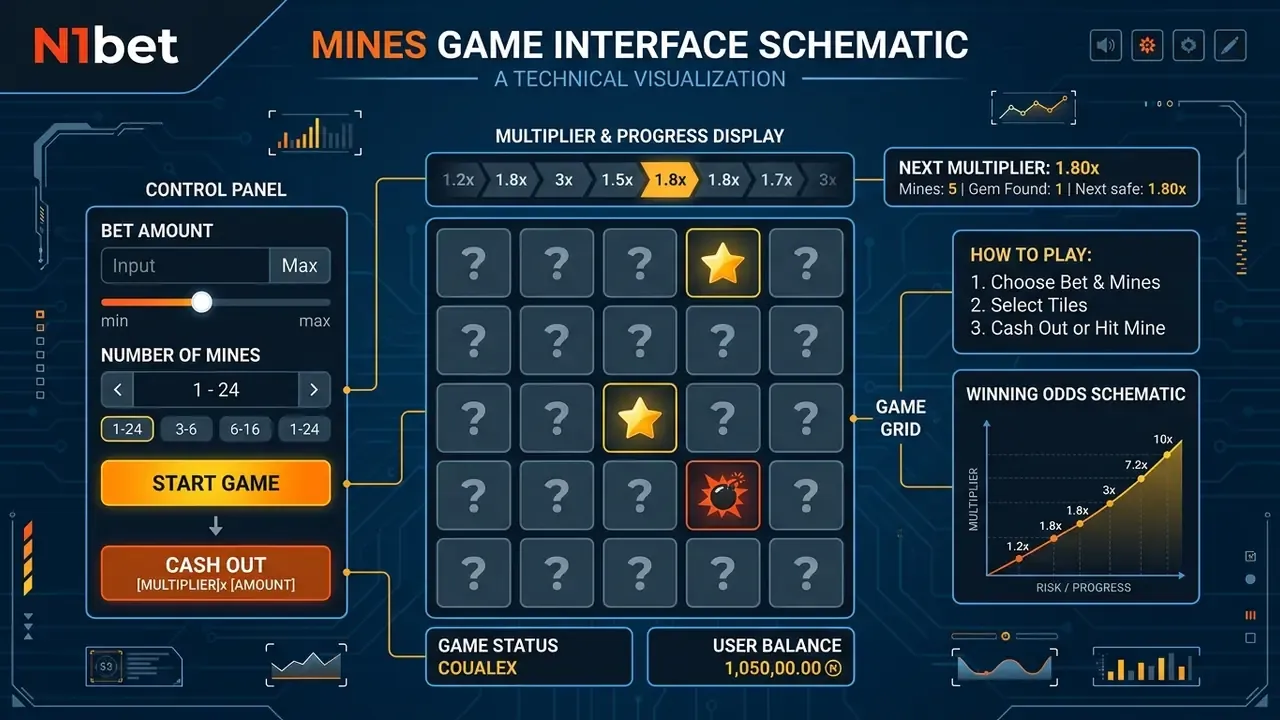
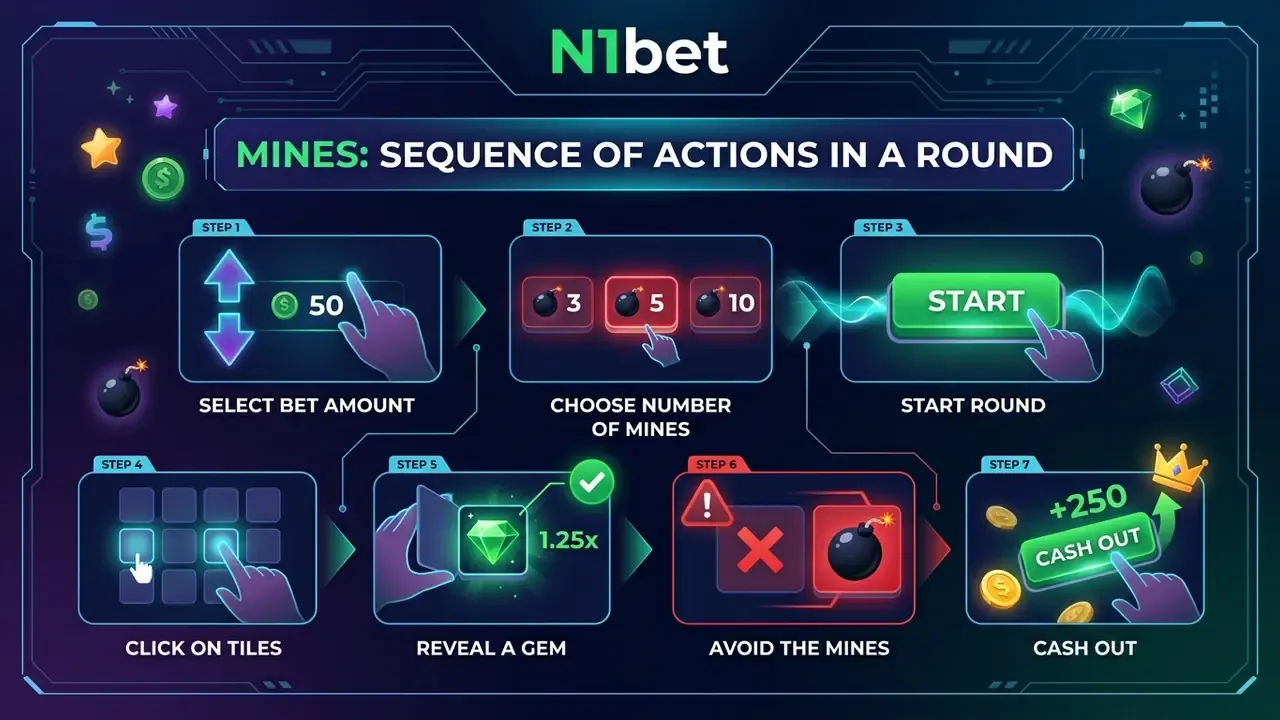
The standard mines game field is a 5x5 grid of 25 hidden tiles, concealing a user-selected quantity of mines plus safe gems. While 5x5 is the industry default, custom fields run from 3x3 (nine tiles, ultra-fast rounds) up to 8x8 or 9x9 at providers such as Turbo Games. Before the round starts, you configure the number of mines, usually anywhere from 1 to 20, with several studios allowing up to 24.
Pick fewer mines (one to three) and you leave a high ratio of safe tiles on the grid: frequent hits, modest multiplier growth. Add more mines and the field becomes crowded, so every tile you reveal carries real risk but triggers a steeper multiplier jump. The probability of a safe first click is:
$$\text{Probability (Safe)} = \frac{T - M}{T}$$
Where $T$ is the total number of tiles (25) and $M$ is the chosen number of mines. After each successful reveal, both $T$ and the remaining safe count fall by 1, so the risk of hitting a mine on the next click keeps rising. Expressed generally, after $k$ safe reveals the next-tile loss probability equals $M / (T - k)$. That is exactly why risk compounds the longer you stay in a round.