Gonzo's Quest Slot: Demo Play, Avalanche Mechanics, RTP and Real-Money Guide

Provider

NetEnt

RTP

95.0996.00%

Volatility

Medium-high

Min bet

0.20

Max bet

NZ$50

Max win

3,750x

Gonzo's Quest Slot Demo Play, Avalanche

title: "Gonzo's Quest Slot: Demo, RTP 95.09–96%, Max Win 3,750x" description: "Gonzo's Quest review for NZ players: free demo play, Avalanche multipliers to 15x, 41.10% hit rate, RTP ranges 95.09%–96.00%, full paytable and real-money checks."

Written and fact-checked by the PlayWise NZ editorial team. Last updated: April 2026. The house method is simple: each title is examined in both demo and real-money builds, the in-game help files are read line by line, and operator settings are compared before anything is published. More on that method, plus the wider game coverage, sits in the iGaming hub.

title Gonzo's Quest Slot Demo, RTP

Responsible gambling notice. This article is informational and does not replace professional advice. Real-money gambling carries financial risk. Check that online gambling is legal where you live, and that you meet the legal minimum age, before you stake anything.

Quick facts

  • Gonzo's Quest was released by NetEnt on 11 November 2011 as a 5×3 video slot with 20 fixed paylines, built around the Avalanche™ cascading-symbol mechanic.
  • Hit frequency is 41.10%, roughly one paid outcome every 2.43 spins. That is unusually active for a medium-high volatility game.
  • The slot ships with configurable RTP ranges: the best setting is 96.00%, the worst commonly seen setting is 95.09%.
  • Maximum win is 3,750× the total stake (NZ$187,500 at the NZ$50 maximum bet), not 2,500× as several review sites state. The 2,500-coin figure is the top line payout, before the 15× Free Falls multiplier lands on top.
  • The original 2011 slot has no Bonus Buy button. Bonus purchase exists only in later releases, namely Gonzo's Quest Megaways and Gonzo's Quest Remastered.
  • Demo mode replicates every feature (Avalanche, Free Falls, multipliers, paytable) using virtual credits, and always displays the 96.00% RTP figure regardless of the operator's live setting.
Quick facts. - Gonzo's Quest was

  1. Introduction: why this 2011 slot still matters

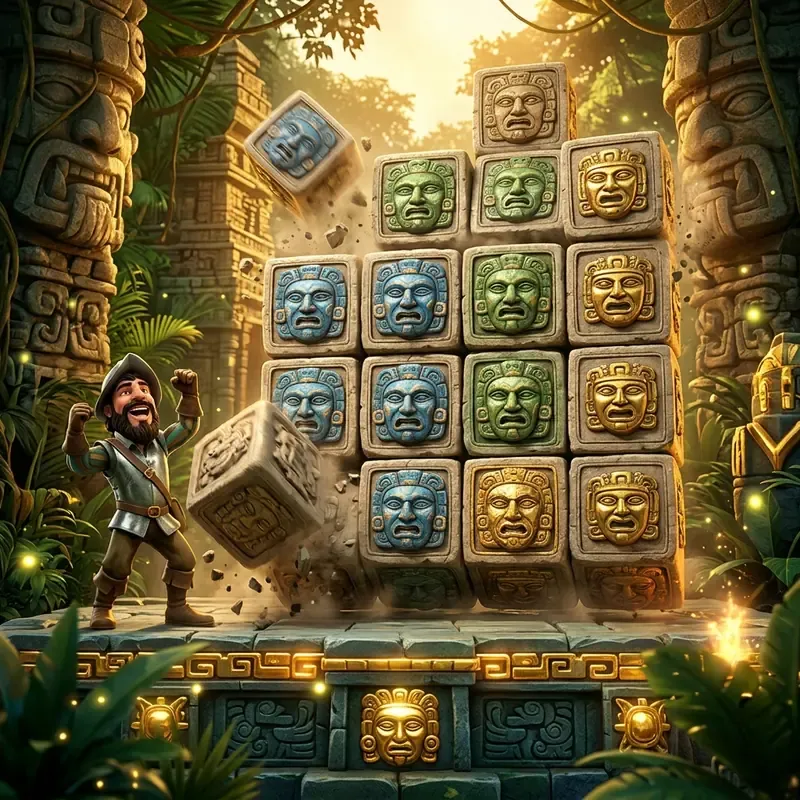
Gonzo's Quest is one of a small handful of online slots that changed how the whole product category is designed. Before it, the standard video slot spun five reels, stopped them, paid what landed and moved on. NetEnt replaced that loop with falling stone blocks: winning symbols detonate, fresh blocks drop into the gaps, and a multiplier trail climbs with every consecutive win inside the same paid spin. Fifteen years later, cascading or "tumbling" reels are an industry default, and almost every studio ships at least one game that owes its core loop to Gonzo.

Why should a Kiwi player care about a 2011 release in 2026? Because it is still stocked almost everywhere, still used to clear wagering, and still described inaccurately by a surprising number of review pages.

This guide does three things that most reviews of the game do not. First, it separates the original 2011 NetEnt release from its later relatives, because much of the confusion online (bonus buys, differing max-win figures, contradictory release dates) comes from writers blending versions together. Second, it treats the mathematics seriously: RTP ranges, house edge, hit frequency, multiplier ladders and the practical bankroll arithmetic that follows from them. Third, it summarises peer-reviewed behavioural research from 2021 to 2025 on demo play, RTP messaging and volatility, so you can read the numbers in the light of what researchers actually know about how players interpret them.

One PlayWise NZ principle runs through all of it. Facts before marketing gloss, and the downsides stated as plainly as the upsides.

1. Introduction why this 2011 slot

2. What Gonzo's Quest Is as a Modern Online Slot

2.1 Theme, visual design and symbol set

The premise is a conquistador narrative. Gonzo, a stylised nod to Gonzalo Pizarro, hacks through South American jungle in search of El Dorado, the mythical golden city that drew Spanish expeditions for centuries. The reels sit inside a carved stone frame in front of an Inca-style temple, water pours from a sculpted face, and the ambient track is a bed of birds, insects and dripping foliage. When symbols land, they sound like real masonry tumbling. It has a rhythm you can feel.

Want to try Gonzo's Quest without money on the line? A free demo build is available at Casino, which is the sensible way to learn the Avalanche mechanic before you think about real stakes.

Gonzo himself stands to the left of the grid, reading his map, scratching his beard, spinning his helmet when nothing happens, and on a decent hit dancing, fist-pumping and occasionally moonwalking across the screen. That character animation is a big part of why the game aged gracefully. The pixel density is dated on a modern 4K monitor and some frames look choppy, yet the personality survives.

Every paying symbol is an Inca carving on a square block. Seven of them pay, split into three low-value murals and four higher-value masks:

  • Murals (low pays):grey, orange and yellow stone plates with geometric patterns.
  • Masks (high pays):pink, yellow, green and finally a grey-blue face with gold trim, the top symbol.
  • Wild:a grey stone with a golden question mark, which substitutes for paying symbols.
  • Free Fall (scatter):a solid gold medallion with a face at its centre.
N1bet heading-banner

2.2 Base mechanics: reels, lines and bet range

The playing field is a 5-reel, 3-row grid with 20 fixed paylines. Lines cannot be switched off. The stake is adjusted through coin value and bet level instead. Wins are formed left to right from reel one, three or more matching symbols on a line.

ParameterValue
ProviderNetEnt
Original release date11 November 2011
Grid / paylines5×3 / 20 fixed
Coin values0.01, 0.02, 0.05, 0.10, 0.20, 0.50
Bet levels20, 40, 60, 80, 100
Minimum bet per spinNZ$0.20
Maximum bet per spinNZ$50.00
Maximum win3,750× stake (NZ$187,500 at max bet)
Top line payout2,500 coins (5× grey mask)
Hit frequency41.10% (≈1 win every 2.43 spins)
VolatilityMedium-high
RTP settings in circulation95.09% – 96.00%
Key featuresAvalanche™, multiplier trail, Free Falls, Wild
Bonus BuyNo (original release)
Progressive jackpotNo
Gamble featureNo
Mobile supportYes (HTML5 / NetEnt Touch)

2.3 Full paytable: what each symbol pays

Payouts below are expressed as multiples of the total stake, which is how most players actually think about a result. Note the steep gap between the top mask and everything beneath it, a classic medium-high volatility signature.

SymbolDescription3 of a kind4 of a kind5 of a kind
Grey mask (gold trim)Top-paying mask2.5×12.5×125×
Green maskHigh pay1.0×5.0×50×
Yellow maskHigh pay0.75×2.5×25×
Pink maskHigh pay0.5×1.25×10×
Yellow muralLow pay0.25×1.0×
Orange muralLow pay0.2×0.75×3.75×
Grey muralLow pay0.15×0.5×2.5×
WildGolden question markSubstitutes for paying symbols in base game and Free Falls
Free Fall (scatter)Gold medallionThree on a payline award 10 Free Falls

2.4 Interface elements you will actually use

Multimedia placeholder: annotated screenshot of the Gonzo's Quest slot interface. Labels point to the reels, the symbol blocks, the spin button, the bet display and the multiplier meter. Alt text must include the phrase "gonzos quest slot", and every label is duplicated as text below the image.

If you are orienting yourself for the first time, six controls matter:

  • Spin starts a single paid round.
  • Autoplay runs a pre-set number of rounds. NetEnt's advanced settings let you define stop conditions: single win exceeds, cash increases or decreases by a set amount, feature triggered.
  • Level is the bet-level selector, 20 to 100, which multiplies the coins staked per line.
  • Coin value is the denomination applied to each coin.
  • Balance shows available funds, real or virtual.
  • Win shows the amount returned by the current round, updated after every Avalanche.

The multiplier meter sits at the top-left of the frame and is the single most important read on the screen. It tells you which rung of the multiplier ladder the current cascade chain has reached.

2.4 Interface elements you will actually

3. How to Play Gonzo's Quest Demo Free

3.1 Prevalence and functions of demo modes

Free-play demos are now a standard shelf item at almost every licensed operator and aggregator. They exist for two reasons at once. They let a curious visitor learn a game's rhythm at zero cost, and they act as a low-friction acquisition funnel for the operator, serving marketing and design purposes together.

«Around 65% of new online slots players use a demo mode before their first real-money wager.» — Gambling Industry Report (2023), industry analytics overview of demo versions. (URL not supplied in the source brief.)

That figure is worth holding onto, because it makes the demo the default first contact point with a game like Gonzo's Quest rather than a niche curiosity. Players who then move on to real stakes typically do so at an online casino where the same title is available in cash mode.

In the Gonzo's Quest demo you get:

  • the full 20-payline, 5×3 base game;
  • the complete Avalanche cascade loop and multiplier trail (1× → 2× → 3× → 5×);
  • the Free Falls bonus with its 3× → 6× → 9× → 15× ladder, retriggers included;
  • the full paytable and help screens;
  • virtual credits that reset on refresh and cannot be withdrawn.

The one thing the demo does not show you reliably is the operator's live RTP setting. Demo builds and logged-out sessions display the 96.00% default. That distinction is covered in detail in section 5.

That figure is worth holding onto

3.2 Behavioural research on simulated gambling

Demo play is not psychologically neutral, and the research literature has become considerably more precise about this since 2021. A 2023 study examining the order in which people first encounter simulated versus monetary gambling found that engagement with most simulated gambling products is associated with greater harm from monetary gambling. Causality may run both ways, though. Simulated play may prime later monetary play, and people already inclined toward gambling may also seek out simulated products first.

The practical reading is not "never use demos". It is that a demo teaches you mechanics far better than it teaches you outcomes. Free-play builds sit under the same RNG in principle, but a short demo session is at the mercy of variance and can leave a badly calibrated impression of how often the Free Falls bonus arrives. Two hundred demo spins is enough to learn what a cascade chain feels like. It is not enough to estimate a hit rate.

3.2 Behavioural research on simulated gambling

3.3 How to launch Gonzo's Quest on mobile

Gonzo's Quest was reworked for touch devices via NetEnt's Touch / HTML5 platform, with the mobile build rolling out from 2014 onward. That is where the widely-copied "2014 release date" originates. The current HTML5 client runs in-browser on iOS and Android without a download, and on Windows, macOS and Linux desktops. Compatibility is broad, which matters for a New Zealand audience that mostly plays on a phone in the evening.

The portrait mobile layout compresses the multiplier trail into a vertical strip beside the grid. Cascade animation speed is unchanged, and no feature is removed. Free spins, wilds and the full multiplier ladder all behave the same way on a 6-inch screen as they do on desktop. One small practical note: on older Android handsets the tumble animation can stutter slightly, which makes it harder to read the meter mid-chain.

Note (updated): the 29 November 2014 date circulated by some databases refers to the mobile/HTML5 conversion, not the game's launch. The original desktop release was 11 November 2011.

3.3 How to launch Gonzo's Quest

3.4 Age and financial risk boundaries

Alert: demo play and real money are not the same thing. Demo access is often open to anyone without registration, which is precisely why the boundary matters. Real-money play is legally restricted to adults, and the threshold is jurisdiction-specific. New Zealand and the UK set 18+, while several regulated markets, including parts of the United States and Asia, require 21+ for casino wagering. Operators must apply the local rule, and licensed sites verify identity and age before a first cash stake is accepted.

The moment you switch from virtual credits to real-money wagering at a casino, three things change at once. Gambling law applies, AML and identity checks apply, and the outcome of every cascade carries a monetary consequence. Set a deposit limit and a session limit before that switch, not after it. That order matters more than any staking pattern.

4. Avalanche Feature and Free Fall: How the Bonus Functions Work

4.1 How Avalanche™ works, step by step

The Avalanche mechanic replaces spinning reels with falling masonry. The event chain inside a single paid round looks like this:

  1. Spin. Fifteen blocks drop into the 5×3 grid.
  2. Evaluation. The game checks all 20 paylines for three or more matching symbols from the left.
  3. Explosion. Winning symbols detonate and are removed from the grid.
  4. Fall. New blocks drop from above to fill the gaps.
  5. Multiplier increment. The multiplier trail advances one rung.
  6. Re-evaluation. If the new arrangement pays, return to step 3.
  7. Round ends. When a cascade produces no win, the chain stops and the multiplier resets.

Multimedia placeholder: flow diagram of the Avalanche loop, following spin → winning combination → fall → multiplier increase → next fall or end of spin. The seven stages above serve as the accessible text version of the same diagram.

Because the chain continues as long as wins keep forming, one paid spin can produce five or six consecutive payouts. This is the source of the game's unusual texture. A 41.10% hit frequency means most rounds do something, and roughly one in eight paid rounds chains at least twice.

4.1 How Avalanche works, step by

4.2 Avalanche Multipliers in base game and Free Falls

The multiplier trail is the profit engine, and it runs on two different ladders depending on which mode you are in.

Avalanche stageBase game multiplierFree Falls multiplier
1st win (start of chain)
2nd consecutive win
3rd consecutive win
4th and subsequent wins15×

The win multiplier applies to the win produced by that specific cascade, so current win × current multiplier, and it resets to the starting rung (1× in the base game, 3× in Free Falls) as soon as a cascade fails to pay.

4.3 Free Fall and the conditions for free spins

Three Free Fall scatter symbols on a payline, left to right across the first three reels, award 10 Free Falls. Landing further scatters during the bonus retriggers additional free spins on the same scale. Because the ladder starts at 3× and tops out at 15×, a four-deep chain during the bonus is worth three times what the same chain pays in the base game. This is why the bonus rounds, and not the base game, hold the meaningful outcomes.

Important clarification: the original slot has no Bonus Buy. Free Falls can only be reached by landing three scatters. Bonus purchase appears in Gonzo's Quest Megaways (Red Tiger) and Gonzo's Quest Remastered (NetEnt), and in some operator-specific builds. Several major review sites conflate these versions. If a page tells you the 2011 slot has a feature-buy button, treat the rest of its numbers with caution.

4.3 Free Fall and the conditions

4.4 Winning streaks, volatility and losses disguised as wins

Cascading slots have a documented psychological side-effect. They multiply the number of on-screen "win" events per unit of money staked. Some of those events return less than the stake, a phenomenon researchers call losses disguised as wins (LDWs).

A 2023 Australian study by Myles and colleagues sought to replicate and extend earlier research on LDWs using a large online sample of 940 adults.

«Only about 38% of participants correctly interpreted LDWs as losses, while around 39% mistook all LDWs for wins.» — Myles et al. (2023), randomised online experiment, n = 940, Australia. (URL not supplied in the source brief.)

In other words, on a game that celebrates a sub-stake return with animation, sound and a rising counter, roughly two in five players read a net loss as a win. Gonzo's Quest is not an outlier here, since the design is standard for cascading slots. Still, the combination of Avalanche chains, a visible multiplier trail and a character who dances on small hits does plausibly amplify the salience of "winning" moments relative to the mundane reality of slow bankroll decline. That last inference is an editorial reading of the mechanic. No published study measuring LDW effects specifically on Avalanche-style slots is known to us, so treat it as a design observation rather than an established finding.

For historical context, an earlier analysis published in 2012 found that around 27% of outcomes on a multiline slot were losses disguised as wins, compared with 52% regular losses and 21% regular wins. Caveat (updated): that figure predates the 2021 to 2025 evidence base used elsewhere in this article and reflects the game configurations of its time. Treat the ratio as indicative of the general phenomenon rather than as a current benchmark for modern cascading titles.

Volatility also shapes how long players spend feeling ahead. A 2023 computational simulation of video poker volatility levels reported that low- and medium-volatility games kept players on winning streaks for around 26.3% and 25.6% of playing time respectively. In the high-volatility condition, roughly 5% of simulated players were still in profit after 100 hours of play, compared with zero players in the low-volatility condition after just 30 hours. Higher volatility buys a smaller chance of a durable win at the cost of a much rougher ride.

In other words, on a game

4.5 Player behaviour across different slot products

Simulations describe games. Panel data describes people. Percy and colleagues (2021) examined how game volatility related to actual play using daily data for 4,281 regular slot players from two operators, applying fixed-effects panel regression. In the casino-oriented operator's data, lower volatility was associated with smaller losses and shorter player sessions. A useful reminder that volatility is not a purely abstract statistic, but a variable connected to how much money leaves an account and how long a session runs.

For a medium-high volatility game like Gonzo's Quest, the operational takeaway is straightforward. Expect frequent small returns punctuated by long droughts between bonus rounds, and size your stake for the drought rather than for the run of small hits.

4.5 Player behaviour across different slot

5. RTP, Volatility and Max Win in Gonzo's Quest

5.1 Defining RTP and house edge

Return to player (RTP) is the proportion of total wagered money a game is mathematically expected to return across an extremely large number of rounds. House edge is the complement: 100% − RTP. It is the house edge, not the RTP, that determines how quickly a bankroll erodes, because the edge is the slice taken from every unit staked.

Disclaimer. RTP information is general in nature. Actual results in individual sessions can differ substantially from the theoretical return figure, in either direction.

5.2 Why players misread RTP messages

RTP disclosure is regulated in several markets on the assumption that it informs players. Recent evidence complicates that assumption. Weiss-Cohen and colleagues (2025) ran a large study on Prolific with 6,062 participants, investigating how different regulatory messages affect perceived chances of winning on a new slot machine.

«Participants shown a "90% RTP" message rated their chances of winning more than five times higher than a no-information control group.» — Weiss-Cohen et al., «Never tell me the odds» (2025), n = 6,062, Prolific. (URL not supplied in the source brief.)

The effects were large, with odds ratios greater than 5. A message intended to convey a 10% average loss was read by many participants as reassurance about their prospects of winning. The direction of that misreading matters for a game whose 95.09% to 96.00% headline looks superficially generous.

5.3 House-edge information, volatility warnings and actual betting behaviour

If percentage-return framing misleads, does an alternative framing help? Newall and colleagues (2022) pre-registered an experiment with 2,433 US participants using a simulated slot machine. Participants gambled significantly less when house-edge information or a volatility warning were shown, compared with standard RTP information.

«Participants shown house-edge information placed an average of 15.7 spins, versus 19.3 spins under the standard RTP message.» — Newall et al. (2022), pre-registered slot simulation, n = 2,433, United States. (URL not supplied in the source brief.)

Applied to this game, the honest framing is not "Gonzo's Quest returns 96%". It is this: on the best available setting, the house keeps about 4c of every dollar staked, and on the worst commonly deployed setting it keeps about 4.91c.

5.4 How studios hit an RTP and volatility target

Slot mathematics is a constrained design problem. The studio picks a target RTP and a target volatility profile, then builds symbol frequencies, reel strips and paytable entries to satisfy both. Published work on applying variable neighbourhood search to slot-machine design (2021) describes how developers can run algorithmic searches over combinations of symbol frequencies and pay table entries to generate a design that meets the return target while also achieving a specific volatility profile. Verification note: no stable public URL for that paper appeared in the source brief, so treat the methodological description as indicative of standard industry practice rather than as a citation you can independently check.

The practical consequence for players is the existence of RTP ranges. Because the same visual game can be tuned to several return settings, an operator's licensing terms and commercial choices determine which build you actually play.

5.4 How studios hit an RTP

5.5 Why RTP can differ between casinos: 96.00% versus 95.09%

Warning: Gonzo's Quest ships in several RTP versions. NetEnt supplies the slot with configurable return ranges:

  • Best setting: 96.00% → house edge 4.00%
  • Worst commonly deployed setting: 95.09% → house edge 4.91%
  • Some databases list the game at 95.97%, a widely quoted mid-range configuration.

A 0.91-percentage-point gap in RTP sounds trivial. Expressed as house edge, it is a 22.7% increase in the rate at which your money is consumed. Here is the arithmetic with a NZ$100 balance at NZ$1 per spin:

SettingHouse edgeExpected spins from NZ$100Approx. session length (at ~3s per spin)
RTP 96.00%4.00%100 / 0.04 = 2,500 spins≈ 2 hours
RTP 95.09%4.91%100 / 0.0491 = 2,037 spins≈ 1.5 hours

Same graphics, same Gonzo, same dance. Just 463 fewer spins, and 463 fewer chances at the Free Falls bonus.

How to check which version your casino runs:

  1. Log in and open Gonzo's Quest in real-money mode. Demo and logged-out sessions display the 96.00% default and will mislead you.
  2. Open the in-game help or information tab, the "?" icon.
  3. Page through to the line reading "The theoretical RTP of this game is…".
  4. You will see 96.00%, 95.97% or 95.09%, depending on the operator's configuration.
  5. On builds that include a feature buy (Megaways or Remastered), a second RTP figure for the purchased bonus is usually listed, and it normally tracks close to the base setting.

That five-step check is a small habit with a real payoff. It is also the kind of verification step PlayWise NZ treats as non-negotiable before a rating is published.

Same graphics, same Gonzo, same dance

5.6 How to read max win: 3,750×, not 2,500×

This is the single most common factual error in Gonzo's Quest coverage. The top line payout is 2,500 coins for five grey masks. With the 15× multiplier active during Free Falls, the ceiling for a single winning event rises to 3,750× the total stake, so NZ$3,750 from a NZ$1 spin, or NZ$187,500 at the NZ$50 maximum bet.

Reformulated for accuracy: NetEnt does not publish the probability of hitting the maximum win for this title, and no independent lab report in the public domain quantifies it. By analogy with comparable medium-high volatility games with four-figure ceilings, the probability of a max win event is extremely low, and the great majority of players will never encounter it within realistic play durations. Flagged here as a reasoned inference, not a Gonzo-specific published statistic.

For perspective, 3,750× is a respectable but modest ceiling by 2026 standards. Modern high-volatility releases routinely advertise 10,000× to 60,000×, and a handful of extreme titles quote seven-figure multiples. If a colossal top prize is your priority, Gonzo's Quest is not the game. If a high hit rate with a lively bonus is what you want, it still holds up well.

5.6 How to read max win

5.7 Comparative characteristics: demo versus real-money play

Table caption: Gonzo's Quest key parameters compared across demo and real-money modes.

CharacteristicDemo modeReal-money mode
BalanceVirtual credits, resets on refreshActual funds, withdrawable
Displayed RTPAlways 96.00% defaultOperator's live setting (95.09%–96.00%)
Volatility experiencedMedium-high, but variance-distorted in short sessionsMedium-high, felt across the full bankroll
Max win potential3,750× shown, no cash value3,750× stake, up to NZ$187,500
Avalanche + multiplier trailFully availableFully available
Free Falls + retriggersFully availableFully available
Registration / KYCUsually noneMandatory (age and identity verification)
Bonuses and wageringNot applicableApplicable; check contribution and wagering terms
Financial riskNoneReal, including total loss of stake
Psychological exposureLoss aversion largely absentLoss aversion active; chasing risk present
Suitable forLearning mechanics, pacing, feature behaviourActual wins and losses

Fact-check before you deposit. RTP, max win, bonus buy availability and bonus terms all vary by version and by site. Verify each of them in the specific build you are about to play, using the in-game help file and the operator's terms page. At Casino you can read the current setting and the bonus rules before registering.

6. Gonzo's Quest Real Money: What to Check Before Playing at a Casino

6.1 What actually changes when you switch

Demo and cash modes run the same mechanics, so the change is not in the game. It is in you. Three shifts occur simultaneously:

  • Financial. Every wager now reduces or increases a finite balance. Repeated losses shrink future staking capacity and increase the risk of ruin.
  • Psychological. Loss aversion activates. Outcomes that felt neutral in demo now register as losses, and the temptation to chase after a bad run appears.
  • Structural. Bankroll management becomes relevant for the first time. Stake size must be set against your balance and the game's volatility, not against how much fun a bigger bet feels.
6.1 What actually changes when you

6.2 Casino bonuses and the Gonzo's Quest bonus buy question

Gonzo's Quest is a popular wagering-clearance game precisely because of its 41.10% hit frequency. A high proportion of rounds return something, which produces a smoother turnover curve than a high-volatility title with a 20% hit rate. Points to check in the terms before you accept any offer:

  • Wagering multiple. Published NetEnt-linked bonus terms for the title commonly specify 35× the bonus for free-spins winnings. Operator-level offers vary widely. Anything above 30× on a deposit bonus deserves scrutiny, and offers requiring you to wager deposit and bonus effectively double the requirement. Worked example: a NZ$100 bonus at 35× means NZ$3,500 of turnover, which is 3,500 spins at NZ$1.
  • Slot contribution. NetEnt's official game materials do not publish a per-title contribution percentage. That is set by the operator. Slots typically contribute 100% while table games contribute far less. Verify it in the promotion's terms, not in a review.
  • "No wagering" bonuses. Frequently these are non-withdrawable bonus credits. The label sounds generous, so read what it actually permits.
  • Max bet while wagering. Many operators cap the per-spin stake during bonus play. Exceeding it can void winnings.
  • Bonus buy. The original slot has none, so any offer promising a purchased Free Falls round is describing Remastered or Megaways. Some jurisdictions prohibit feature buys outright.

Rule of thumb: the more impressive a bonus headline sounds, the more carefully the fine print needs reading.

6.2 Casino bonuses and the Gonzo's

6.3 Age, regulation and consumer-protection checks

Disclaimer. This information is general in nature and does not replace advice from a qualified professional. Real-money gambling involves financial risk. Confirm that online gambling is legal in your jurisdiction and that you are of legal age before playing.

Before depositing anywhere:

  1. Licence. Confirm the operator holds a valid licence recognised in your jurisdiction, and that the licence number resolves on the regulator's own register. With New Zealand's move to a licensed, harm-minimisation-focused framework, this check has become far easier to make.
  2. Age threshold. 18+ in New Zealand, the UK and most European markets; 21+ in several US states and some Asian jurisdictions. The site's demo label is irrelevant, since the local statutory age governs.
  3. Verification. Legitimate operators complete identity and age checks before or shortly after the first deposit, not only at withdrawal.
  4. Payouts. Check stated withdrawal timeframes, NZD payment methods and whether the cashier explains its steps clearly. A trustworthy cashier is boring in the best way.
  5. RTP transparency. A site that publishes its RTP configuration, or lets you read it in-game before you deposit, is telling you something useful about itself.
  6. Player-protection tools. Deposit limits, loss limits, session reminders, reality checks, cooling-off and self-exclusion should be present and easy to find.
  7. Game certification. Look for independent testing-lab involvement, for example eCOGRA or iTech Labs, at the operator or supplier level. No publicly downloadable Gonzo's Quest certificate for a specific lab appeared in the current source set, so verify certification claims through the regulator's register rather than a marketing badge.
Before depositing anywhere 1. Licence. Confirm

6.4 Three rules for a controlled Gonzo's Quest session

  1. Fund for 150 to 200 spins minimum. Because of medium-high volatility, the Free Falls bonus arrives roughly once every 150 to 200 spins on average. On a NZ$100 bankroll that implies a stake of no more than NZ$0.50 per spin. Betting NZ$5 a spin on NZ$100 gives you 20 spins, which is statistically close to a coin flip on whether you see the bonus at all.
  2. Use the 41.10% hit rate deliberately. The high hit frequency makes the game a sound choice for clearing wagering requirements at steady turnover, but the benefit is partly cancelled if your operator runs the 95.09% build. Check the setting first, then decide.
  3. Know which version you are playing. Do not assume feature parity with Gonzo's Quest Megaways. The original has no Bonus Buy, a fixed 20-payline grid and a 3,750× ceiling. The Megaways build has variable ways, a different volatility profile and, at many operators, a purchasable bonus.

A fourth, unglamorous rule: read the multiplier meter, not the sound design. A cascade chain that ends at the 2× rung on a low-pay mural is, more often than not, a loss dressed as a win. And set your deposit and time limits before the first spin, not after the first bad run.

6.4 Three rules for a controlled

7. Similar NetEnt Slots for Gonzo's Quest Fans

7.1 The Gonzo family

  • Gonzo's Quest Megaways (Red Tiger, under the NetEnt and Evolution umbrella). The cascading concept rebuilt on the Megaways engine, with variable ways to win, an unlimited multiplier trail during free spins and, at many operators, a bonus buy. Higher volatility than the original.
  • Gonzo's Quest Remastered (NetEnt). A visual and mathematical refresh of the 2011 game that explicitly includes a Bonus Buy option absent from the original.
  • Gonzo's Gold. A later expedition entry with a different feature set built around the same character.
  • Gonzo's Treasure Hunt. A live-casino game show rather than a slot, using the El Dorado theme in a hosted format.
7.1 The Gonzo family. - Gonzo's

7.2 NetEnt's portfolio and comparable cascading games

If the appeal is the cascade-plus-multiplier loop rather than the character, the design lineage is broad. NetEnt's own catalogue offers Starburst (low volatility, expanding wilds), Dead or Alive II (very high volatility free spins) and Twin Spin. Cascading mechanics now appear across the market, whether from NetEnt or from other developers such as Pragmatic Play, Play'n GO or Yggdrasil, whose tumbling and cluster-pays titles all descend from the template Gonzo established. You can browse popular slots at an online casino to compare hit rates and volatility side by side.

Comparison anchors worth knowing when you assess Gonzo's Quest against modern releases:

7.2 NetEnt's portfolio and comparable cascading
TitleRTP (typical)VolatilityPaylines / waysCascading reels
Gonzo's Quest95.09%–96.00%Medium-high20 fixedYes
Starburst~96.09%Low10 (both ways)No
Dead or Alive II~96.8%Very high9No
Gonzo's Quest Megaways~96% (range)HighUp to 117,649 waysYes

  1. NetEnt: The Studio Behind the Avalanche

NetEnt was founded in 1996 as the online arm of a Swedish land-based casino operator, and grew into one of Europe's most influential game networks before becoming part of Evolution. Its reputation rests on two things: presentation quality and mechanical invention. Starburst delivered the former. Gonzo's Quest delivered the latter.

The Avalanche mechanic's significance is structural rather than cosmetic. By decoupling "one payment" from "one spin", NetEnt created a design space in which a single wager could generate a chain of escalating outcomes, and in doing so it made the multiplier trail a mainstream feature. Nearly every tumbling, cascading or cluster-pays slot released since owes something to the 2011 release. That is why operators still stock the game fifteen years on, long past the shelf life of almost all of its contemporaries.

Where sources disagree on the launch year, and some industry retrospectives say 2010 while NetEnt's own game documentation and the overwhelming majority of release records say 2011, this guide follows the game documentation: 11 November 2011 for the desktop release, with the Touch and HTML5 conversion following in 2014.

8. NetEnt The Studio Behind the

  1. Conclusion

Gonzo's Quest earns its longevity honestly. The theme is coherent, the character work is charming, the Avalanche loop is still satisfying, and a 41.10% hit frequency keeps a session moving in a way that many modern high-volatility titles do not. It has no jackpot, no second-screen bonus and no feature buy in its original form, and its 3,750× ceiling is modest by contemporary standards. Yet the game does a small number of things extremely well.

What should shape your decision is not the theme but the arithmetic. Verify the RTP setting in real-money mode before you deposit, because 95.09% consumes a bankroll 22.7% faster than 96.00% for identical entertainment. Size your stake for 150 to 200 spins so the Free Falls bonus is a realistic event rather than a lottery. Read the multiplier trail rather than the fanfare, remembering that roughly two in five players misread sub-stake returns as wins. And treat the demo for what it is: an excellent teacher of mechanics, a poor predictor of outcomes.

9. Conclusion. Gonzo's Quest earns its

Moving from theory to practice? Compare the slot catalogue, RTP information and current terms at Casino, set your limits first, and play only within them.

  1. FAQ

11. Corrections and Fact-Check Notes

Several widely-read reviews of this game contain errors that propagate across the web. For transparency, here is what has been corrected and why:

Claim in circulationVerdictCorrect position
Max win is 2,500×Incorrect2,500 coins is the top line pay; with the 15× Free Falls multiplier the ceiling is 3,750× the stake
Gonzo's Quest has a bonus buyIncorrect for the originalBonus Buy exists in Remastered and most Megaways builds only
Release date 29/11/2014Partially correctThat is the mobile and HTML5 conversion; original release 11 November 2011
Single fixed RTP of 96%IncompleteThe game ships with RTP ranges spanning 95.09%–96.00%
Volatility "high"ImpreciseProvider and lab-aligned classification is medium-high
Release year 2010ContestedGame documentation and the majority of release records give 2011

Where a figure could not be verified in a primary source, including maximum-win probability, bonus-round frequency, per-operator slot contribution and a public certification document for this specific title, that gap is stated in the relevant section rather than papered over with an unsourced number.

Responsible gambling. Gambling can be addictive. Set deposit and loss limits before you play, never stake money you cannot afford to lose, and treat any win as a fortunate outcome rather than an expected one. If gambling is causing harm to you or someone you know, contact the free Gambling Helpline (New Zealand: 0800 654 655) or the support service available in your jurisdiction. Make sure gambling is legal where you live and that you meet the statutory minimum age before playing for real money.